People and benches along the Brooklyn waterfront with Manhattan and Brooklyn Bridge beyond
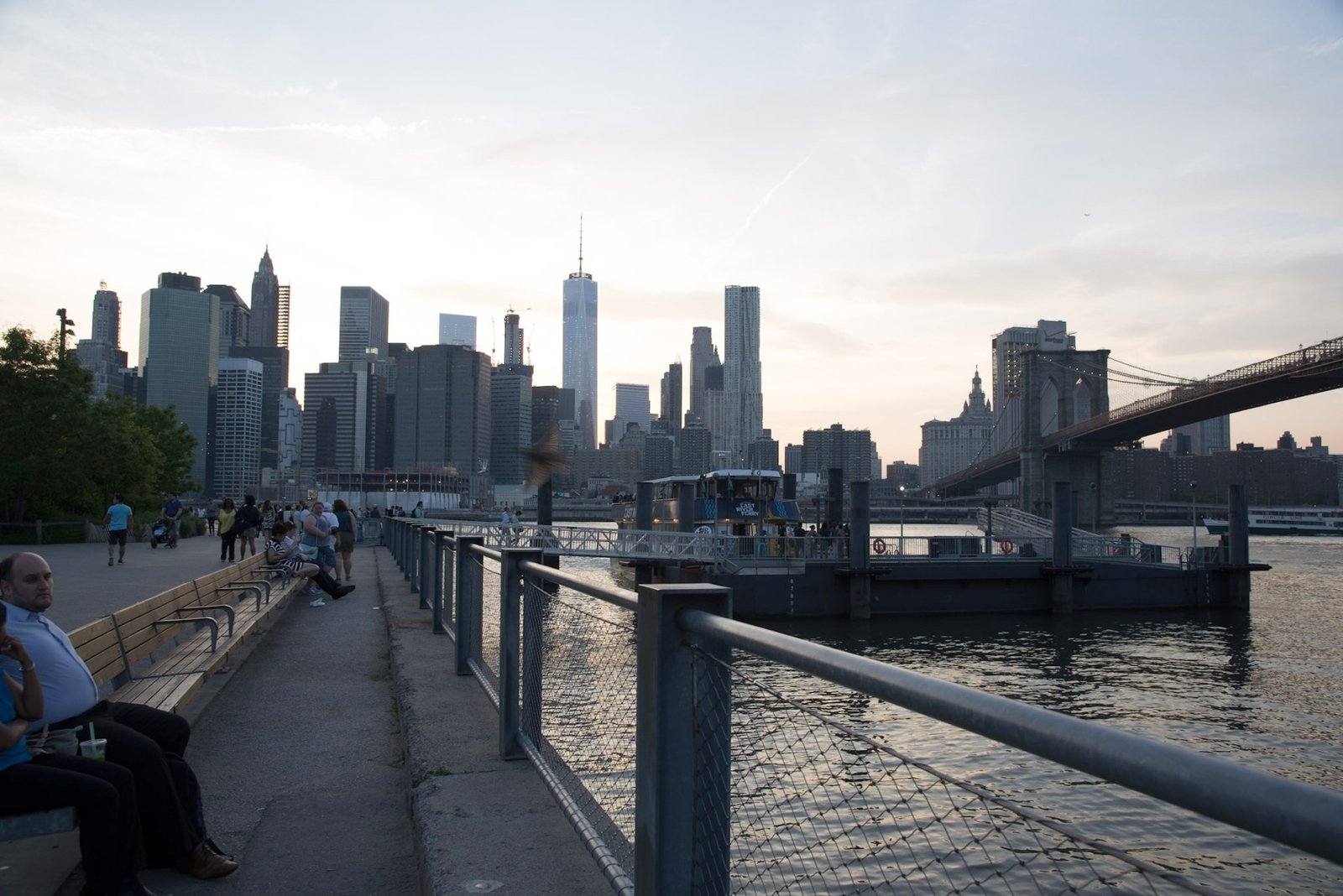
People and benches along the Brooklyn waterfront with Manhattan and Brooklyn Bridge beyond. Photograph by A. Abbady, May 2016.
DUMBO is a place I return to for sunset. The attraction is not simply the moment when the sky becomes warm above Manhattan. It is the longer change that follows: buildings turning into silhouettes, windows becoming points of light, and boats carrying their reflections across the East River. A familiar view can become a different photograph without the photographer moving very far.
This collection follows that transition along the Brooklyn waterfront. The photographs move from the promenade and harbor traffic to the Brooklyn Bridge at dusk, an illuminated passenger boat, and a final view of Manhattan lights reflected in smooth water. Together, they describe an evening through changing light, distance and movement.
These photographs belong to my May 2016 archive; their filenames identify May 26, 2016. They show the waterfront as it appeared then, including its buildings, boats and construction. They should be enjoyed as photographs of that visit rather than as a guide to every detail of the waterfront today. For the wider neighborhood story, continue with DUMBO, Brooklyn: Sunset, History and the Waterfront Between Two Bridges.
An Evening Begins on the Promenade
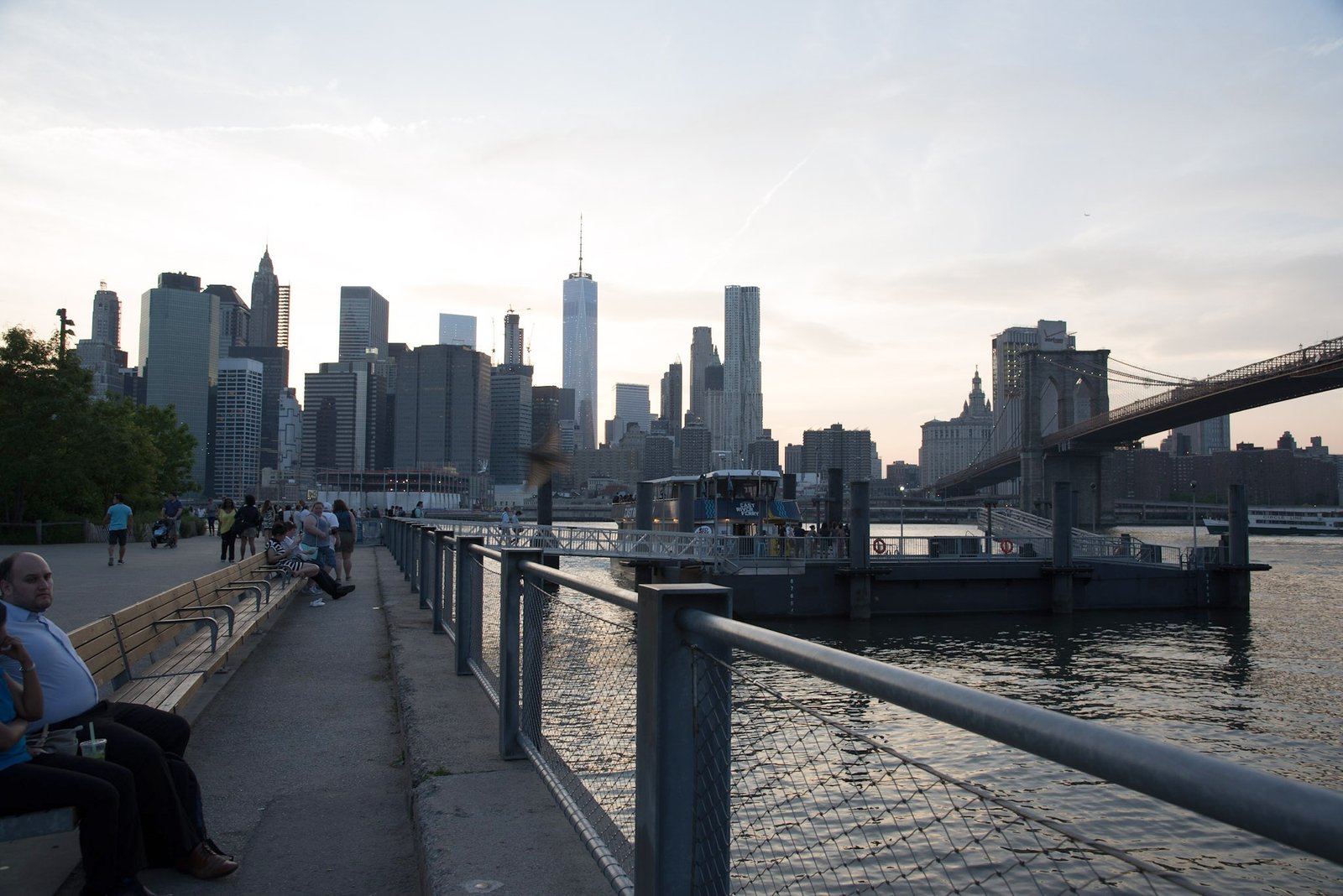
The opening photograph includes benches, people, railings and a ferry landing, with Manhattan rising beyond them. It establishes the experience at human scale. Before the skyline becomes the main subject, the viewer sees the place from which it is being watched. People sit near the water or move along the path; the railing leads the eye toward the bridge.
This foreground matters. A skyline seen alone can appear almost detached from the photographer. A path and a row of benches make the view part of an ordinary evening beside the river. The photograph contains both the distant city and the shared public space facing it. The industrial scale of the buildings is balanced by people occupying a much smaller, more familiar world.
At this stage the sky remains brighter than the waterfront. The buildings hold darker tones, and the river reflects a mixture of sky color and shadow. Preserving some of that difference is part of preserving the evening. Lifting every shadow until it looks like daylight would remove the contrast that gives the scene its time and atmosphere.
Fulton Ferry: A Waterfront Built Around Crossing
The shoreline near the bridge has a history that reaches well beyond its present role as a photographic destination. The New York City Landmarks Preservation Commission describes Fulton Ferry as a neighborhood whose development was inseparable from the ferry crossing. Settlement, markets and businesses grew around the movement of people and goods between Brooklyn and Manhattan. Its surviving architecture records the expansion of commerce and industry during the nineteenth century. [1]
In 1814, Robert Fulton's steam ferry became an important part of that story. Brooklyn Waterfront History, a partnership of Brooklyn Bridge Park and the Center for Brooklyn History, places the service within the transformation of Brooklyn and its connections across the river. Steam power changed the possibilities of regular travel between the two shores. The river was a working connection on which urban growth depended. [2]
The vessels in these photographs are from a much later period. They are not the ferries that shaped the nineteenth-century district. Still, their presence keeps movement central to the view. A landing, a passenger boat and the opposite shore help explain why this location became important. Looking at the water as a route, as well as a reflective surface, gives the photographs a historical dimension.
Boats Give the Skyline a Different Scale
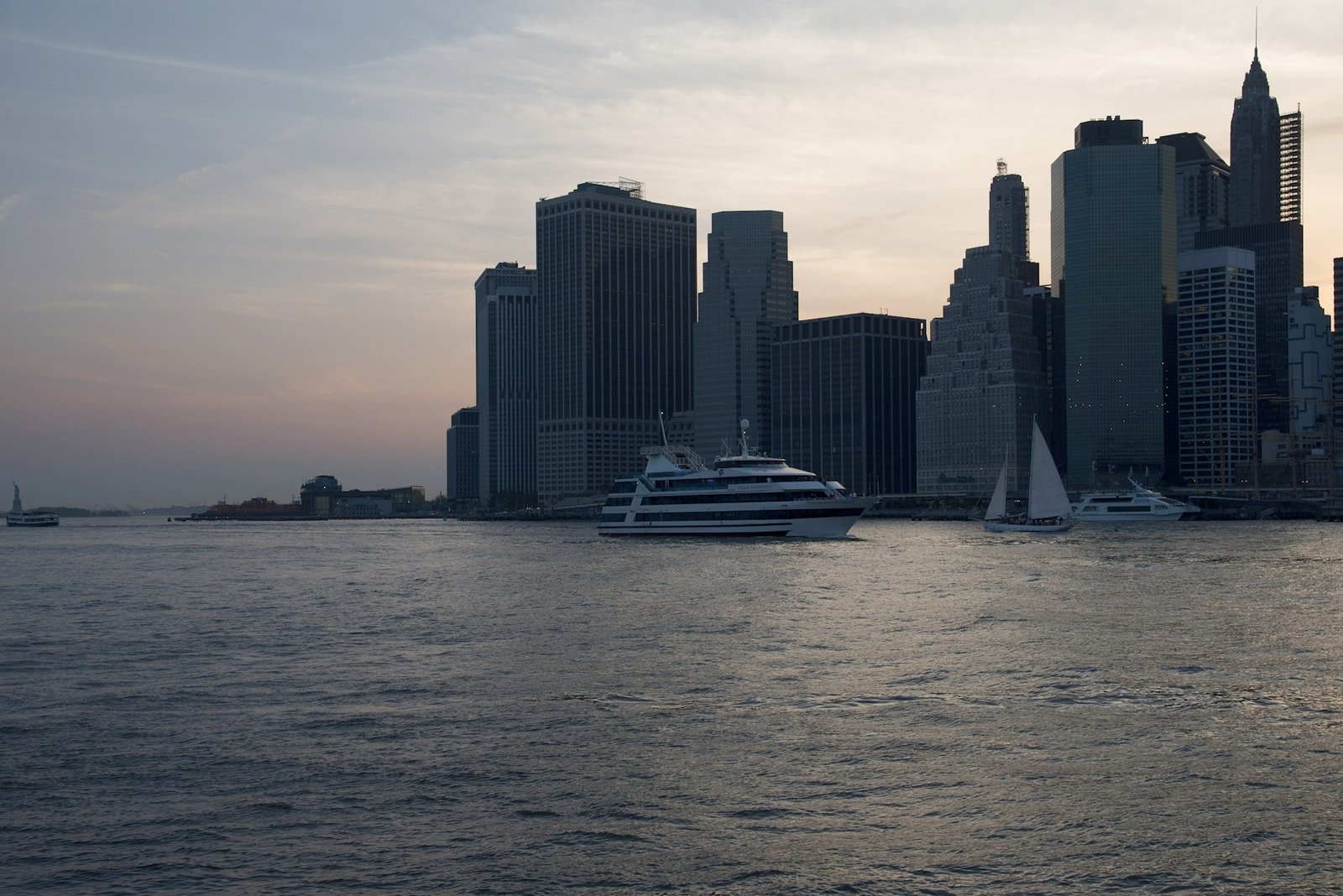
In the yacht-and-sailboat photograph, the buildings form a dense vertical background while the vessels stretch across the lower part of the composition. Their shapes are very different. The yacht has stacked horizontal decks; the sailboat creates a pale triangular accent. Both interrupt the regular patterns of windows and façades.
They also help the viewer judge distance. The waterfront buildings can seem compressed into a single wall when viewed across the river. A boat in front of them creates another layer, separating the water from the city. The open space around the vessels allows the eye to rest before returning to the intricate architecture above.
Photographing a moving subject against a fixed skyline calls for patience with its position. A boat that overlaps a key building, touches the edge of the frame or merges with another vessel changes the balance. For this collection, one view carries that relationship rather than a sequence of nearly identical boat positions. The purpose is to show a different way of seeing the city, not every exposure made while a vessel crossed it.
Looking Toward the Harbor
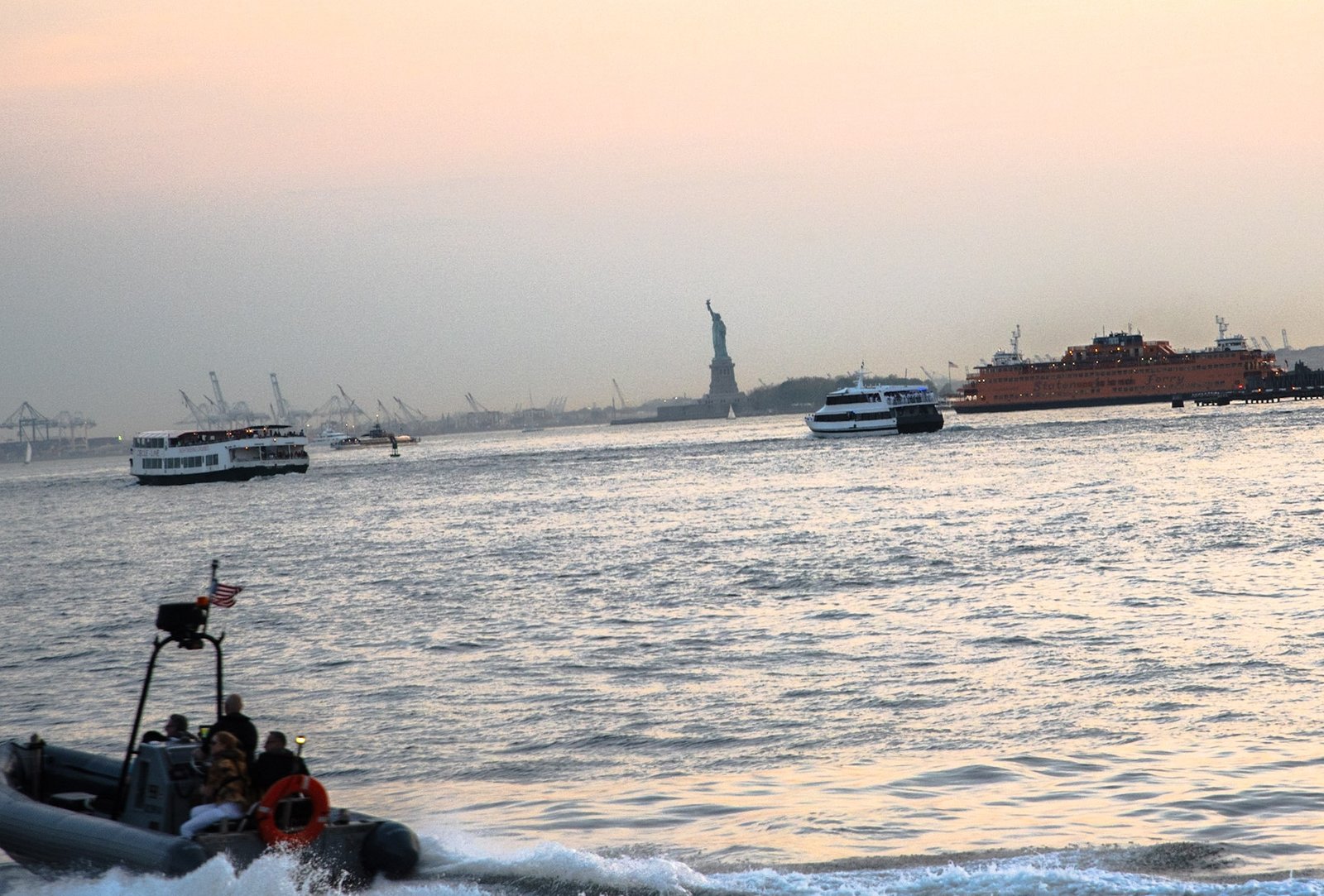
Turning toward the harbor opens the composition. The Statue of Liberty appears in the distance, with passenger vessels and a small motorboat nearer the camera. The monument is deliberately a small part of a much wider scene. Water, haze, sky and traffic become the subject together.
The foreground boat and its wake bring energy to this photograph. They contrast with the slower visual rhythm of the distant ships and shoreline. The warm sky softens toward the horizon, while the surface of the water retains a restless texture. This is a useful change of pace between the more architectural views.
Distance also sets limits on what the photograph can describe. The statue is recognizable in outline, but this is not a study of its sculptural detail. The image works through the relationship between a familiar landmark and the active harbor surrounding it. Keeping that sense of distance is more honest than enlarging a small portion until it suggests detail the original file does not contain.
The Brooklyn Bridge Holds the Composition Together
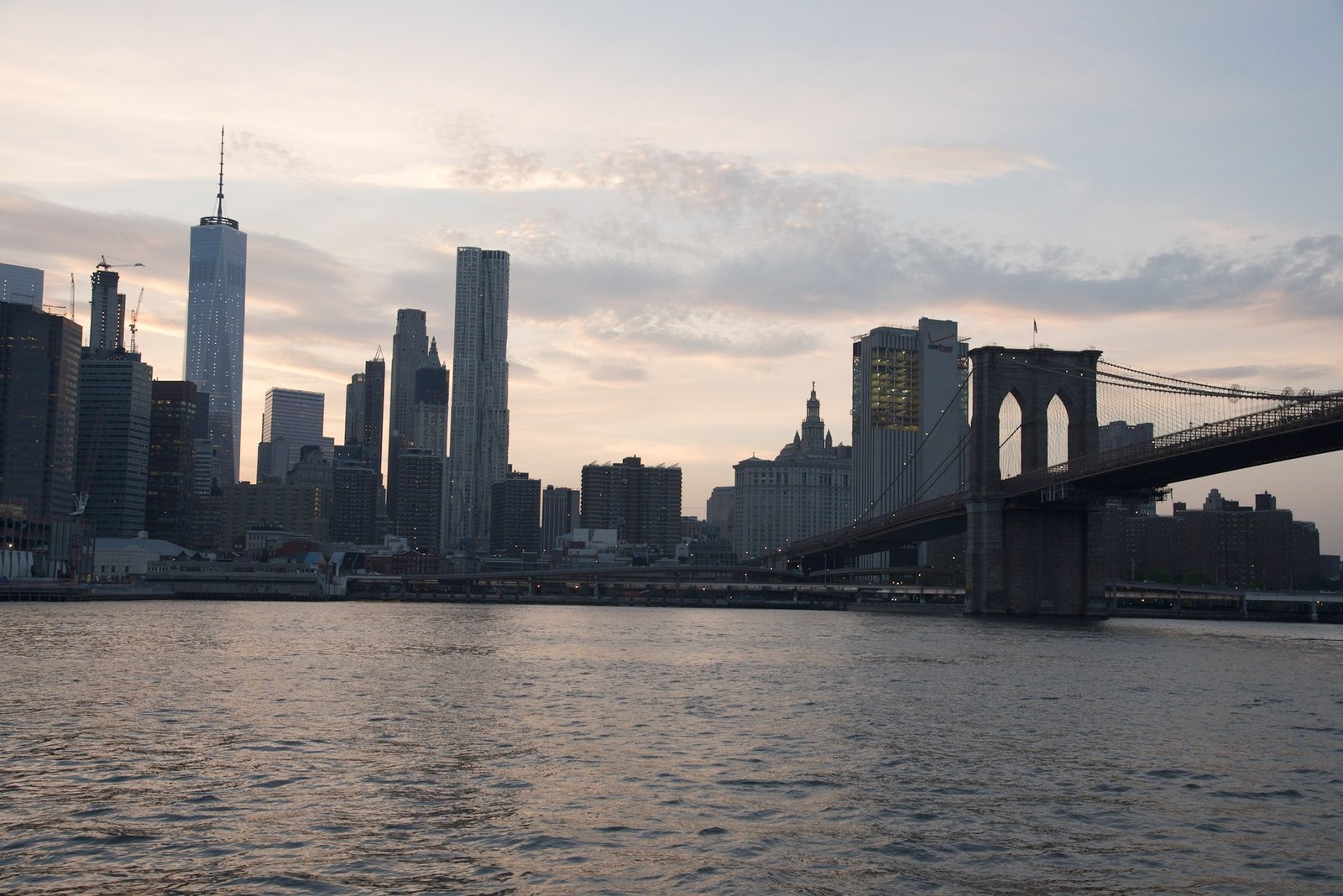
The bridge brings a strong diagonal into a view otherwise dominated by vertical buildings and a horizontal shoreline. Its pointed stone arches remain recognizable even as the tower grows dark against the sky. The cables create finer lines around the massive masonry, giving the photograph both weight and delicacy.
Construction of the Brooklyn Bridge began in 1869, and the bridge opened on May 24, 1883. NYC DOT and the Library of Congress document those milestones in the history of the crossing. At its opening it was the world's longest suspension bridge. Seen in an evening photograph, the structure is both an engineering achievement and a shape that organizes the river view. [3][4]
The project is associated with the Roebling family: John A. Roebling's design, Washington Roebling's engineering leadership, and Emily Warren Roebling's crucial work supporting the project's completion. Brooklyn Bridge Park's account recognizes all three. Remembering those contributions adds a human history to a structure that can otherwise seem timeless. Its familiar silhouette was the result of difficult, sustained work. [5]
In the sunset view, the bridge and Manhattan share the frame without either becoming an isolated landmark. Open sky separates their forms. The river provides a quiet foreground, and the remaining warm light gives the darker structures a clear edge. The photograph depends on that balance more than on dramatic color.
From Working Piers to a Public Waterfront
The ability to linger beside this view is itself part of a more recent history. Brooklyn Waterfront History describes the debate that followed the closure of cargo operations at the piers in 1983. Community advocacy and years of planning helped redirect attention toward public access and parkland. Groundbreaking for Brooklyn Bridge Park followed in 2008, and its first six acres at Pier 1 opened in 2010. [6]
That change gives the promenade photograph an added meaning. A waterfront once shaped by handling cargo also became a place to sit, walk and look across the water. The skyline remained a powerful backdrop, but the relationship between the shore and its visitors changed. Public space made room for a different kind of attention.
The park continued to evolve after these photographs were made. Its current history identifies the 2021 opening of Emily Warren Roebling Plaza as the completion of the park. That later development should not be read backward into this May 2016 collection. Historical photographs preserve stages of a place, including details that later visitors may no longer encounter in the same form. [5]
When a Boat Becomes Part of the Evening Light
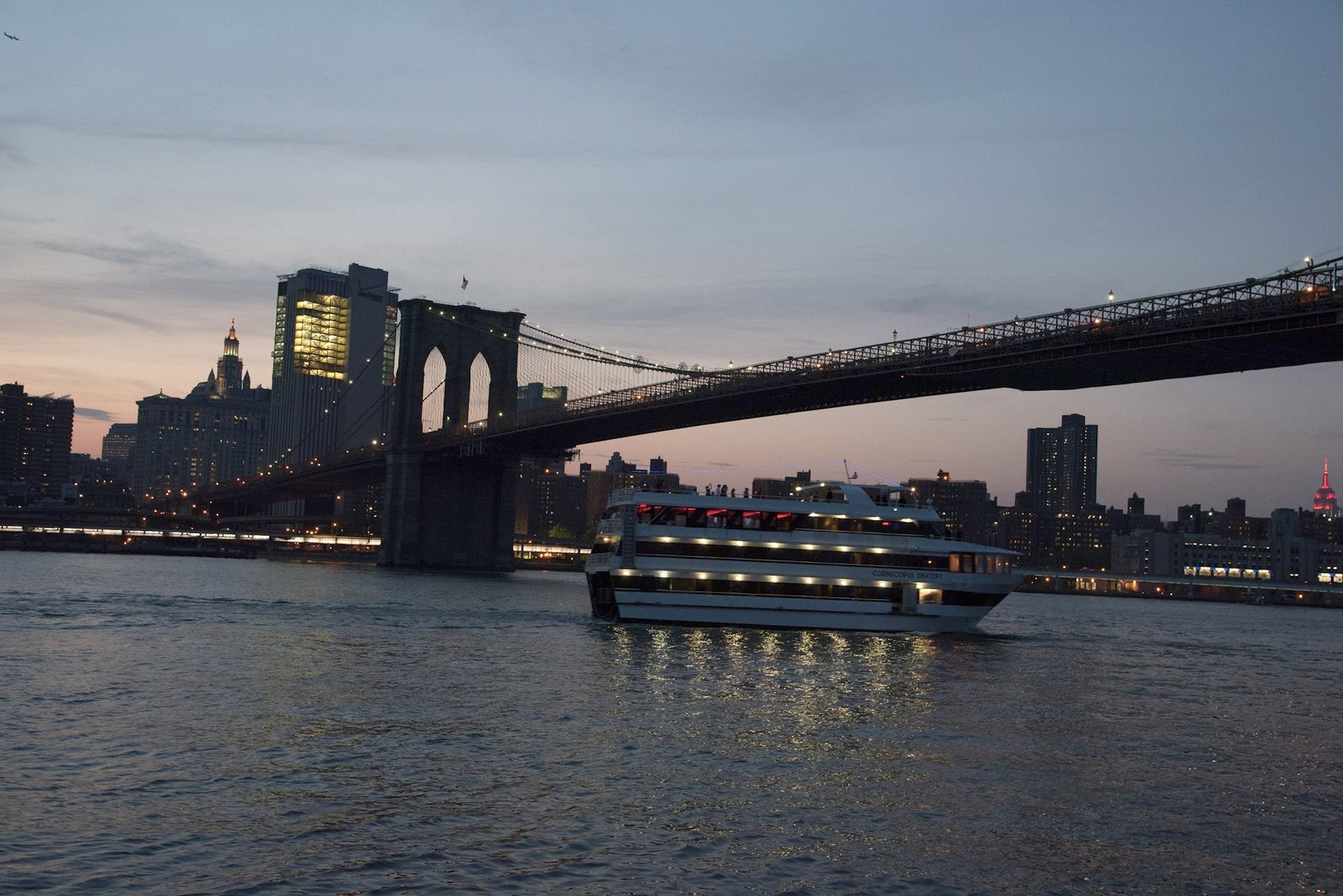
The illuminated passenger boat changes the role of a vessel in the picture. Earlier, the boats provided scale and shape. Here, their artificial lighting becomes a subject of its own. Bright bands along the decks stand against the darker water, while reflections break into short streaks beneath the hull.
The bridge spans the upper part of the photograph, creating a second layer of light and structure. The boat is temporary within the frame; the tower and cables are fixed. Their combination gives the scene a sense of an event taking place within a familiar setting. A moment later the vessel would occupy another position, and the balance would change.
There is still color in the sky. This is one reason dusk can be so rewarding: the background has not yet become uniformly black, and the vessel's lights remain distinct. The photograph retains enough surrounding detail to show where the boat is traveling. Its setting contributes as much as its illumination.
Manhattan Lights and the Passage of Time
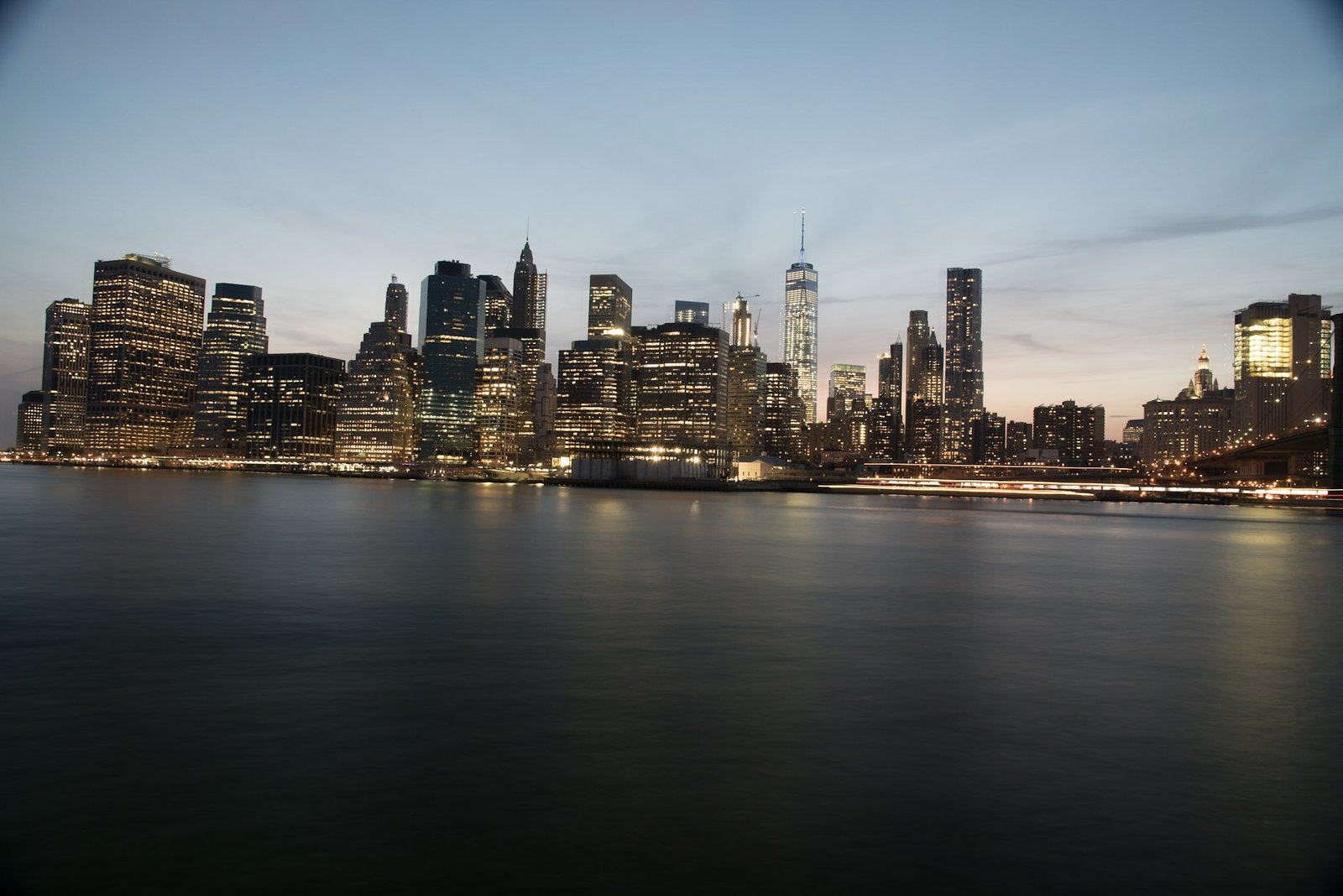
The final photograph changes the appearance of the water. Its surface looks smoother, the building lights spread into soft reflections, and a moving boat leaves a bright horizontal trail. The image presents a different sense of duration from the earlier photographs of individual vessels and textured waves.
That visual effect is consistent with a longer exposure, which records movement over an interval rather than freezing a single instant. The exact shutter time is not available in the supplied export, so this collection does not attach an invented camera setting to the image. The visible result is enough to explain its place in the sequence: solid architecture above, softened movement below.
The city lights remain warm against a cooler sky and river. Keeping that relationship restrained allows the windows and reflections to lead the eye. The original collection contains more strongly colored variations, but this selected view holds closer to a natural evening palette. It provides a calm ending after the activity of the harbor and the passing passenger boat.
Returning to the Same Shore
Returning to a familiar place can make small differences easier to notice. The overall skyline may be recognizable, yet a boat, a cloud opening or the balance between daylight and electric light changes the photograph. A return visit does not need to produce a completely unfamiliar landmark to be worthwhile.
This six-photograph sequence follows several kinds of attention: the public promenade, boats against the city, the wider harbor, the bridge, an illuminated vessel and the reflective waterfront. Each view has a separate purpose. Together they describe why an evening at DUMBO can continue to offer subjects after the most obvious sunset color has faded.
For the streets, brick courtyards, bridge views and broader neighborhood history, explore the original DUMBO photographic journey. This evening collection is its quieter waterfront companion.
Original photography by A. Abbady. May 2016 archive. Natural light and color adjustments preserve the photographed scenes.
Historical Sources and Further Reading
1. NYC Landmarks Preservation Commission: Fulton Ferry Historic District designation report.
2. Brooklyn Waterfront History: historical stories and the 1814 steam ferry.
3. NYC Department of Transportation: Brooklyn Bridge.
4. Library of Congress: Brooklyn Bridge, Fanfare and Fatalities.
5. Brooklyn Bridge Park: Brooklyn Bridge and the Roebling family.
Pingback: DUMBO, Brooklyn: Sunset, History and the Waterfront Between Two Bridges - A. Abbady Travel Photography