Vinohrady Theatre illuminated at night
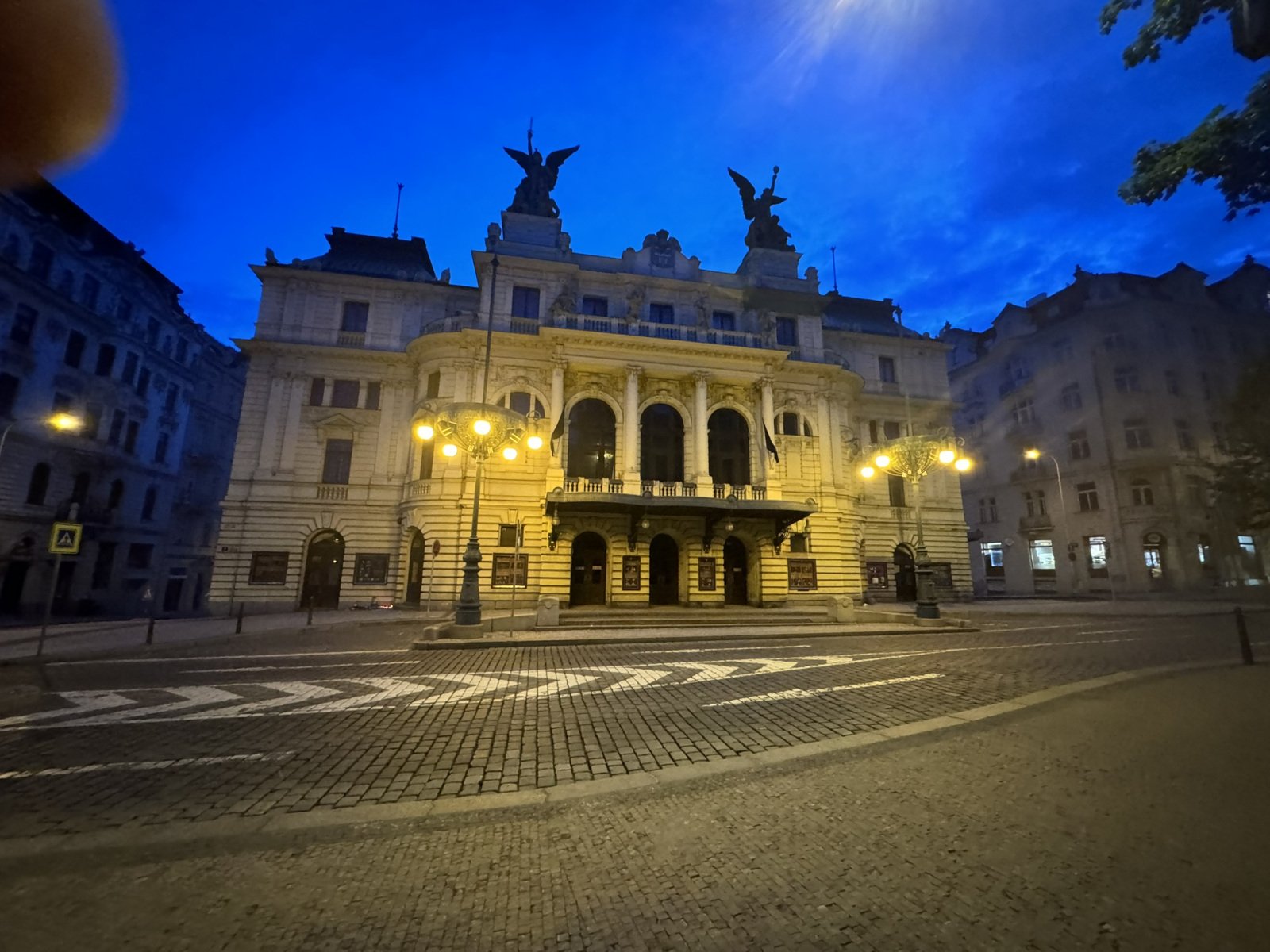
Vinohrady Theatre illuminated at night. Photography by A. Abbady.
A City Revealed One Street at a Time
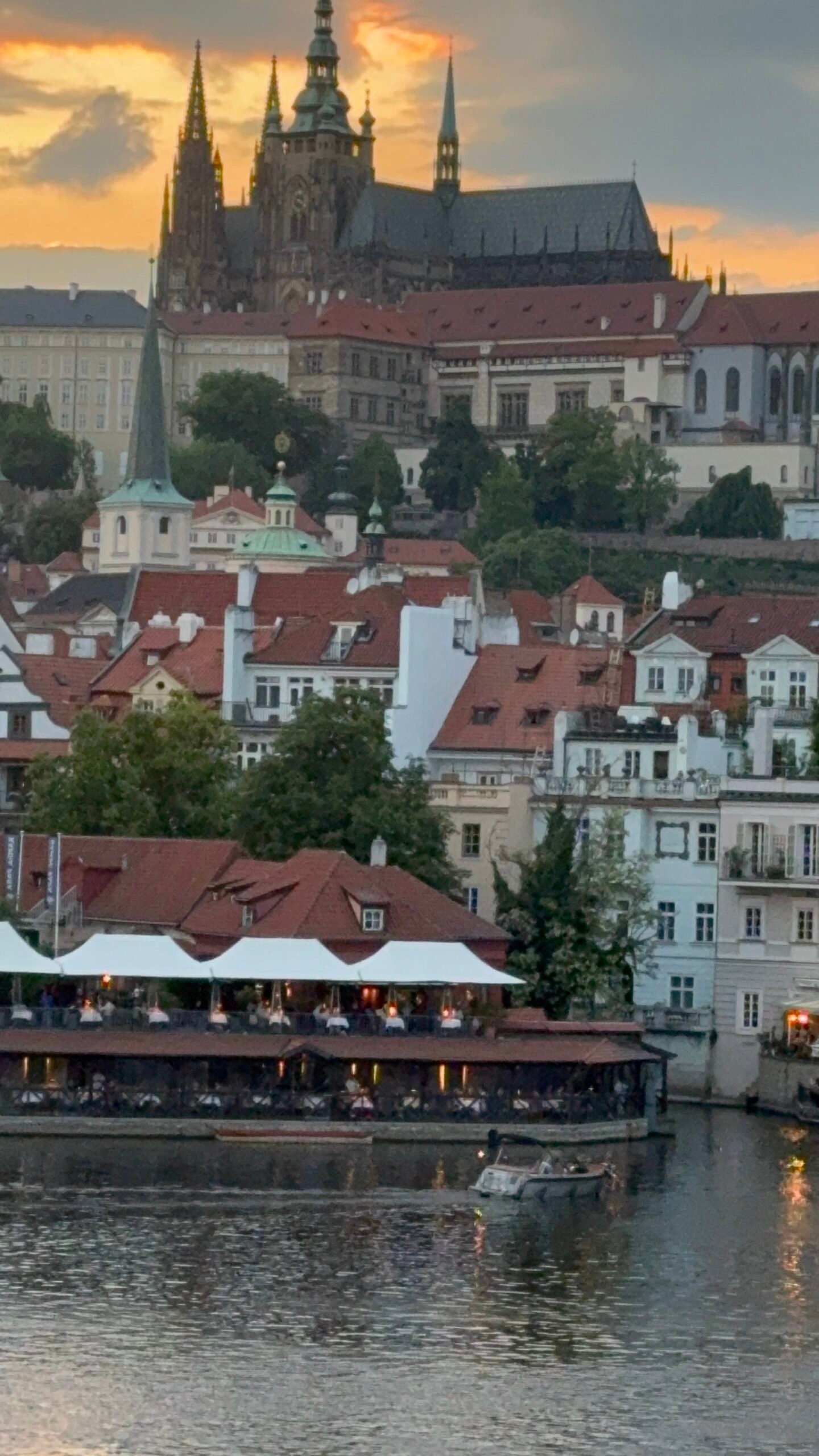
Prague rewards two kinds of looking: the long view across roofs and the close view at pavement level. In this collection, the city moves between those scales. A cathedral rises above a hillside of buildings; a carved doorway fills another frame. Towers interrupt the skyline, while street lamps, parked cars and passing pedestrians keep the photographs grounded in ordinary urban life. These are different ways of entering the same place, each giving the next image a little more meaning.
The historic centre received UNESCO World Heritage recognition in 1992. Its significance lies in an ensemble of streets, buildings and public spaces that records many periods of European architecture. Gothic, Baroque and later forms coexist within a city whose overall historic street pattern remains legible. The contribution of Charles IV in the fourteenth century is especially important to that story. Rather than belonging to one single age, Prague presents a conversation between generations of builders.
That conversation is visible in the photographs without requiring every building to become an isolated landmark. Look at how a tower emerges at the end of a street, how roofs overlap beneath the castle, or how a broad façade changes the proportions of an intersection. The spaces between monuments matter too. They provide the approach, the pause and the sudden opening through which architecture becomes part of a lived city.
The Powder Gate: A Monumental Entrance
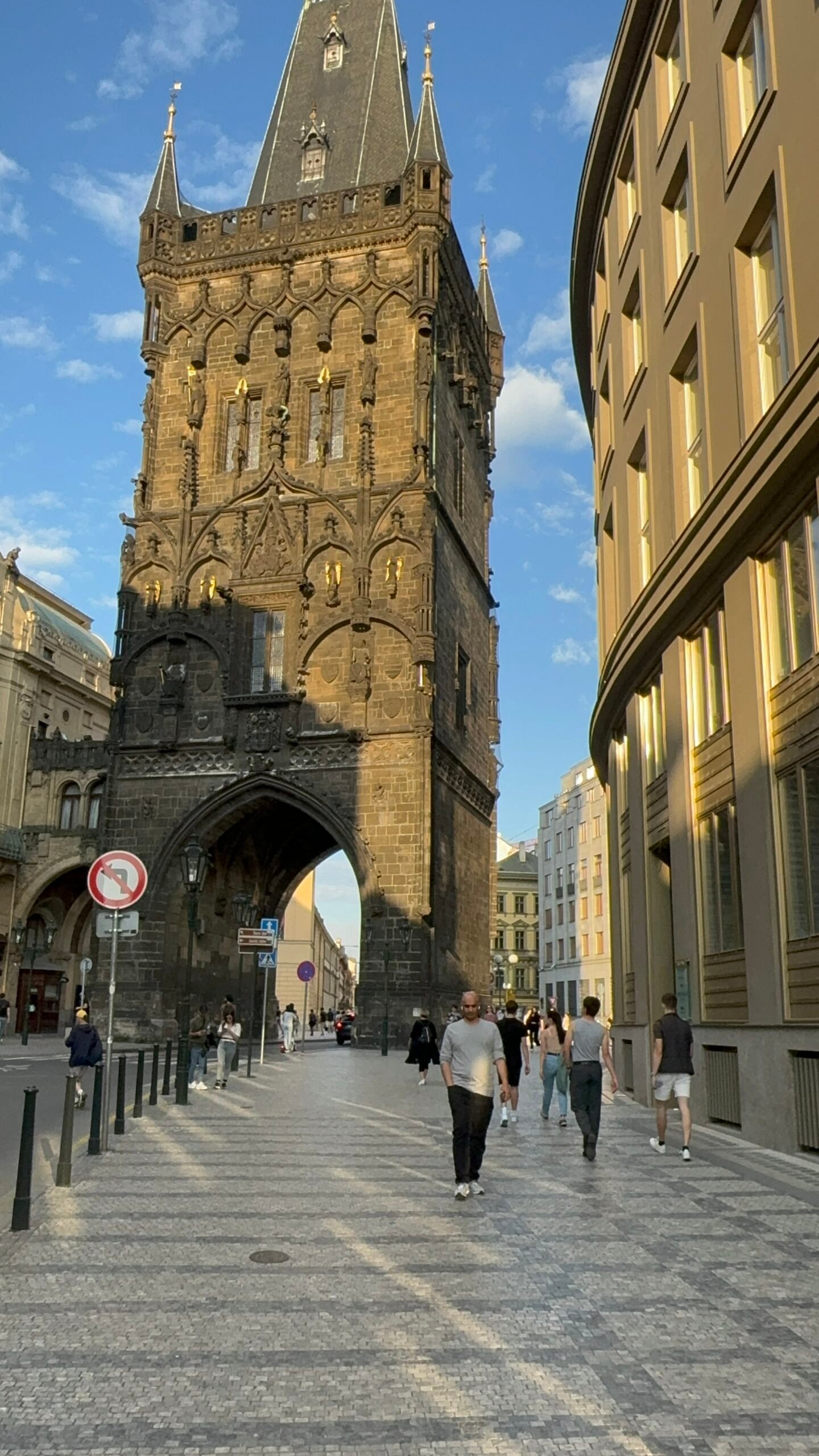
The Powder Gate makes a powerful subject because it compresses so much detail into a narrow vertical form. Its dark surface, sculptural niches and pointed roof stand apart from the lighter buildings around it. In the photograph, the street carries the eye toward the opening beneath the tower. People remain small against its height, making the scale easier to understand than an empty architectural view might do.
Construction began in 1475, with Matěj Rejsek taking over the work in 1478. The gate marked an entrance into the Old Town and the beginning of the royal coronation route toward Prague Castle. Its present appearance also reflects a substantial nineteenth-century restoration under Josef Mocker. That later intervention is an important part of the building’s history: the tower before the camera is the result of construction, interruption, damage and renewal over time.
Its name recalls a different practical role, when gunpowder was stored here. That association contrasts with the ceremonial importance of an entrance used by royal processions. The gate could represent authority, movement and storage at different moments. In a photograph, those uses are no longer directly visible, but knowing them changes the way the arch and the mass of stone are read. A picturesque gateway becomes a record of the city’s changing needs.
Charles Bridge and the Language of Stone
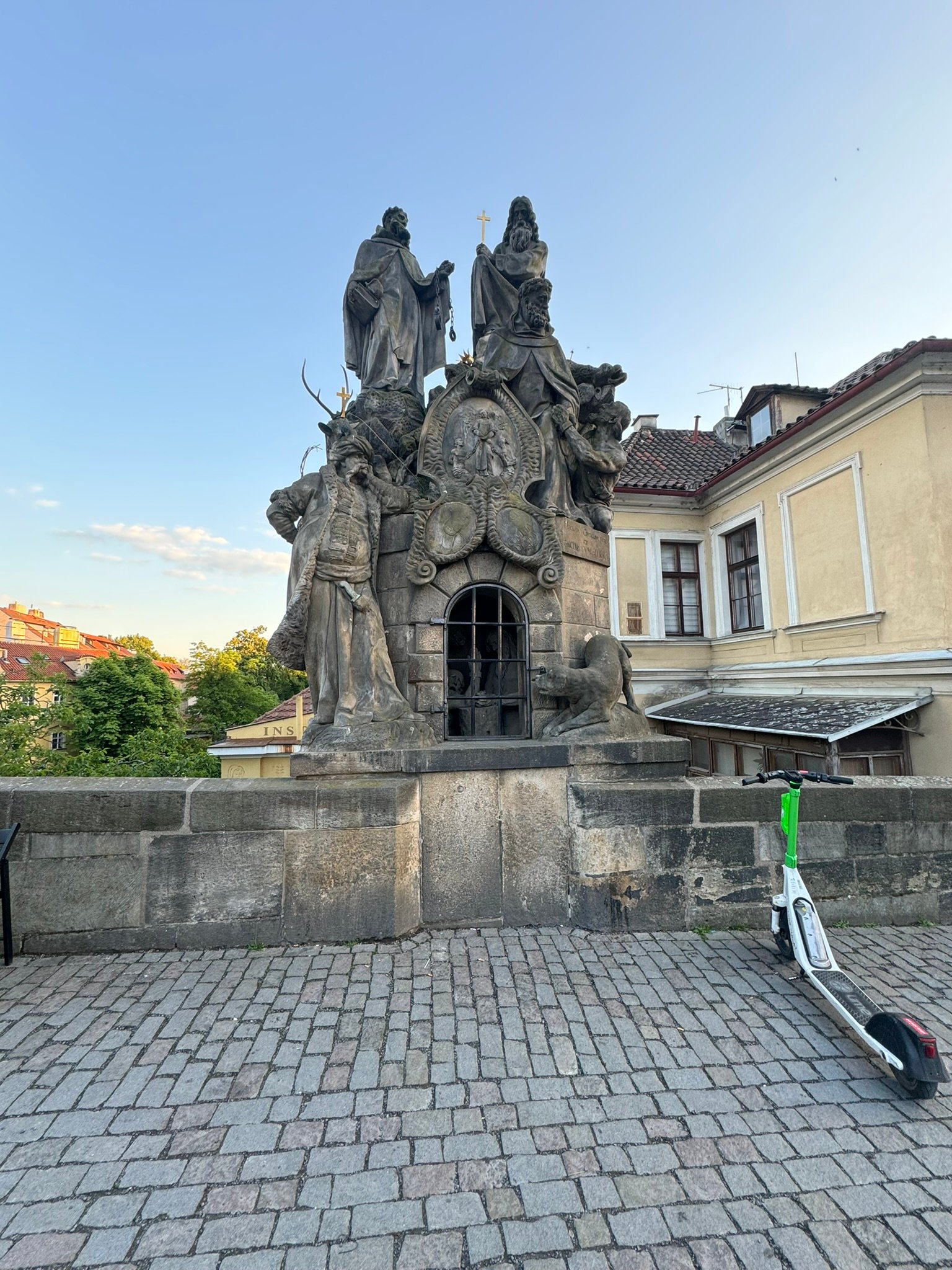
A sculptural group near Charles Bridge introduces another texture: stone arranged as figures, folds and deeply cut shadows. The photograph gives the monument room to occupy the frame, with paving below and neighboring buildings beyond. A modern scooter at the edge makes the meeting of old and present particularly clear. It is a small interruption that also helps explain what travel photography preserves: the surroundings as they appeared at a particular moment.
Charles Bridge was begun in 1357 under Charles IV, replacing the earlier Judith Bridge after severe flood damage. The new crossing was completed in 1402. Its familiar name became established in the nineteenth century. The bridge’s sculptural decoration belongs to a longer sequence of additions, so the crossing should be understood as a structure that acquired new meanings and visual features across the centuries.
The photographs of streets approaching bridge towers are useful companions to the sculpture. They show how the crossing belongs to a wider network of lanes and façades. A bridge is experienced through arrival and departure as much as through the river beneath it. Here, the repeated paving patterns and the glimpse of a tower ahead create anticipation before the viewer reaches the open span. The route itself becomes part of the subject.
Old Town Square and the Astronomical Clock
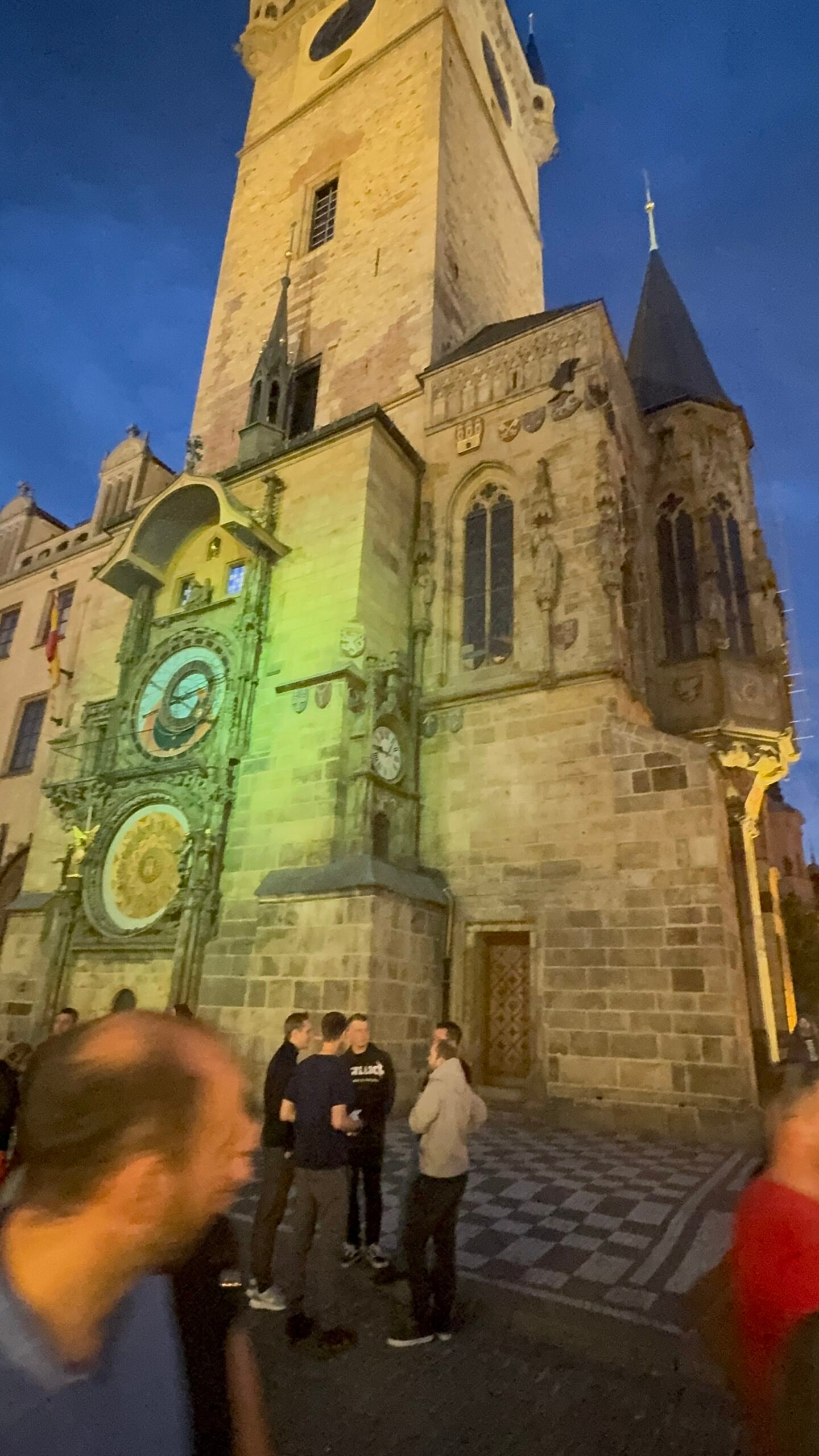
At the Astronomical Clock, the camera turns toward a façade that combines architecture with an intricate instrument. The tower’s height and the circular dials ask for different kinds of attention. One can first read the building as a whole, then return to the smaller components: rings, figures, colors and the relationship between the astronomical display and the calendar below. Even in an evening photograph, the composition suggests that this is much more than a conventional clock.
The oldest mechanical and astronomical elements date to 1410 and are associated with clockmaker Mikuláš of Kadaň and scholar Jan Šindel. The installation changed through later additions and repeated repairs. It suffered serious damage during the Prague Uprising in May 1945, and considerable restoration was needed before it resumed operation in 1948. Its survival is therefore also a story of skilled maintenance and reconstruction.
The accompanying nighttime view toward the Church of Our Lady before Týn places the clock in its wider urban setting. Illuminated spires remain legible above cafés and moving people. The square has no need to become empty to convey its history. The foreground activity reminds the viewer that monumental places continue to function as gathering spaces. The photographs hold the older architecture and the present crowd within the same image.
Vinohrady Theatre: Daylight and Blue Hour
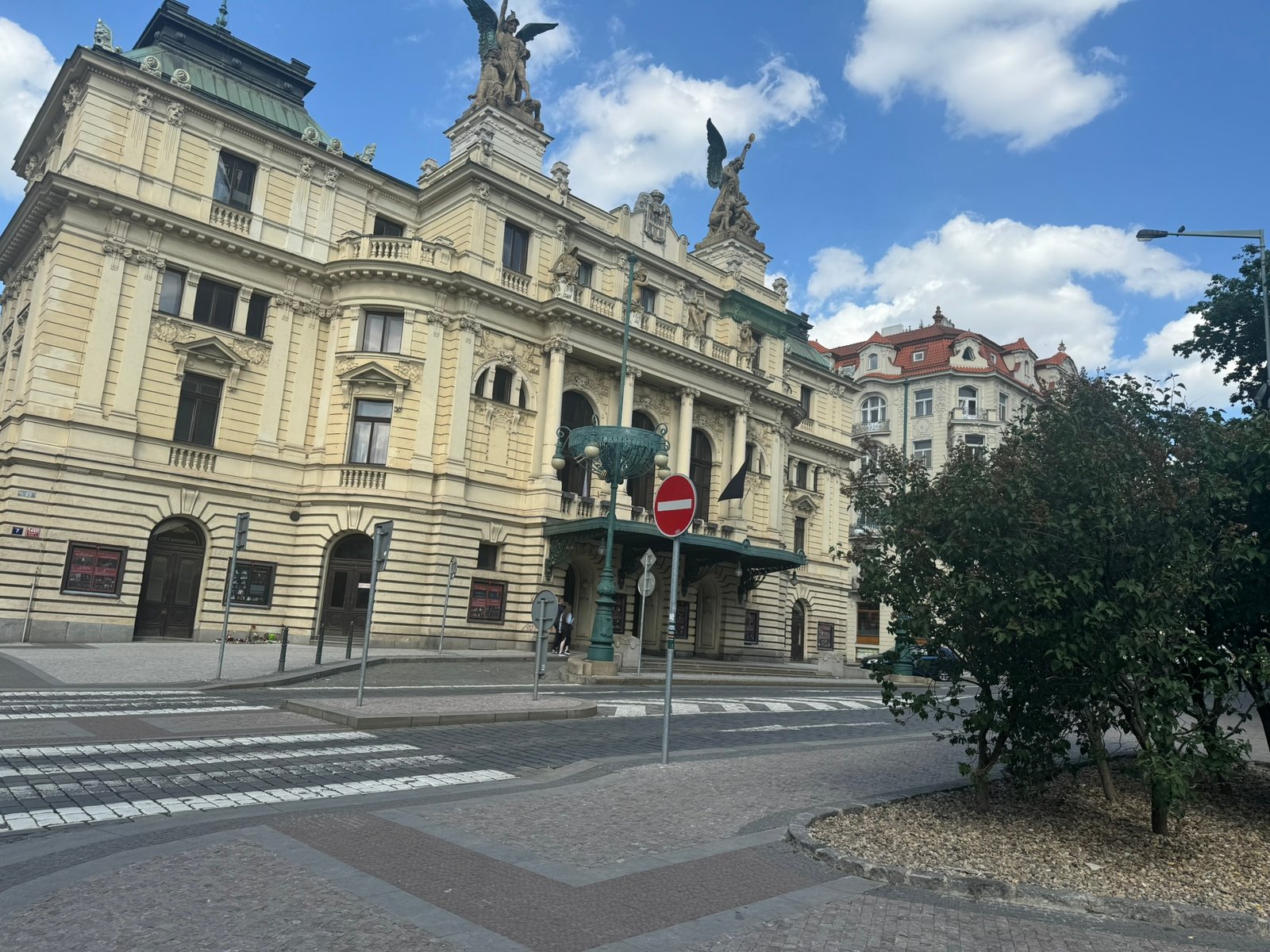
The paired views of Vinohrady Theatre are among the strongest comparisons in this selection. Daylight describes its pale façade and rooftop sculpture with relative evenness. At night, illumination gathers around the entrance and upper windows, while the blue sky separates the roofline from the surrounding darkness. The building has not changed, but the hierarchy of what attracts the eye has shifted.
The theatre was built between 1905 and 1907 to a design by Alois Čenský, and opened in 1907. Its architecture belongs to the Secession or Art Nouveau period. Its development was connected with the growing ambitions of Vinohrady and with Czech-language theatrical culture. The building’s purpose was public and cultural, expressed through a conspicuous presence on the square rather than a hidden entrance along an anonymous frontage.
These two photographs also explain why returning to a subject can produce a different picture rather than a redundant one. In daylight, the surrounding street and crossing lines share the scene with the theatre. After dark, the lighted entrance acquires something of the expectation associated with an evening performance. The nighttime original retains a small intrusion at the upper-left edge; it remains in the gallery as part of the approved, uncropped photograph.
The National Museum and the Public Façade
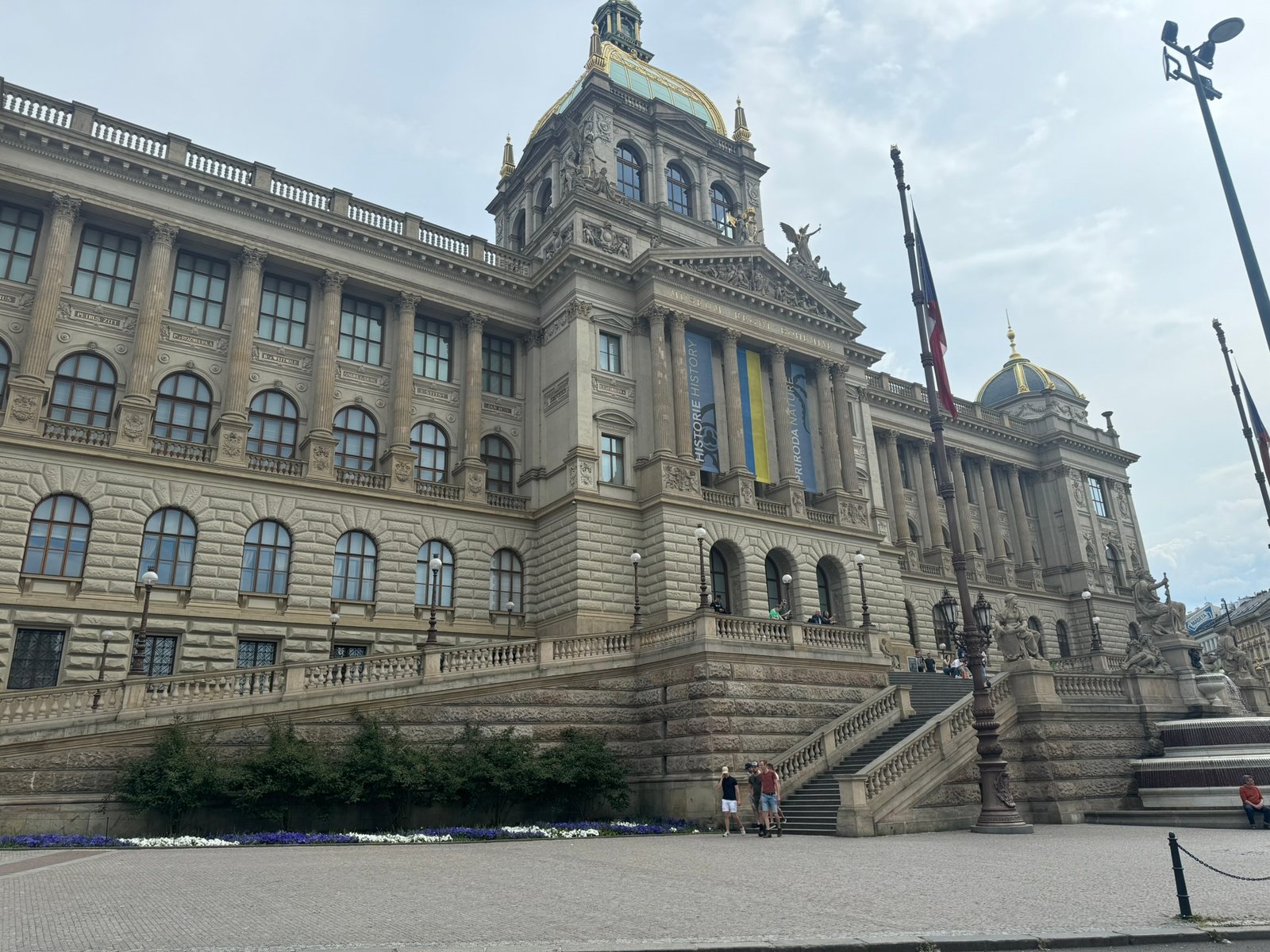
The National Museum appears as a broad, richly articulated building with steps, columns, sculpture and a central dome. Its photograph works through accumulation: the eye moves across repeating windows before finding the more emphatic middle section. The people near the steps are barely more than small marks, yet they help establish the building’s imposing dimensions.
The historic museum building dates from 1891 and anchors the upper end of Wenceslas Square. Its Neo-Renaissance architecture gives the institution a ceremonial face. The building was damaged in 1945 and again in 1968, and later underwent a major renovation, reopening to the public in 2018. Those changes belong to its identity alongside its original architectural ambition.
A museum exterior can communicate a public idea before a visitor sees a single collection inside. Here, the symmetrical arrangement suggests order and permanence, while the decorated skyline makes the institution visible from beyond its immediate entrance. The photograph records that public face. It does not establish an interior visit or describe exhibitions that are outside the frame. Keeping that distinction allows the architecture itself to carry the section honestly.
A Different Prague: Plečnik and the Television Tower
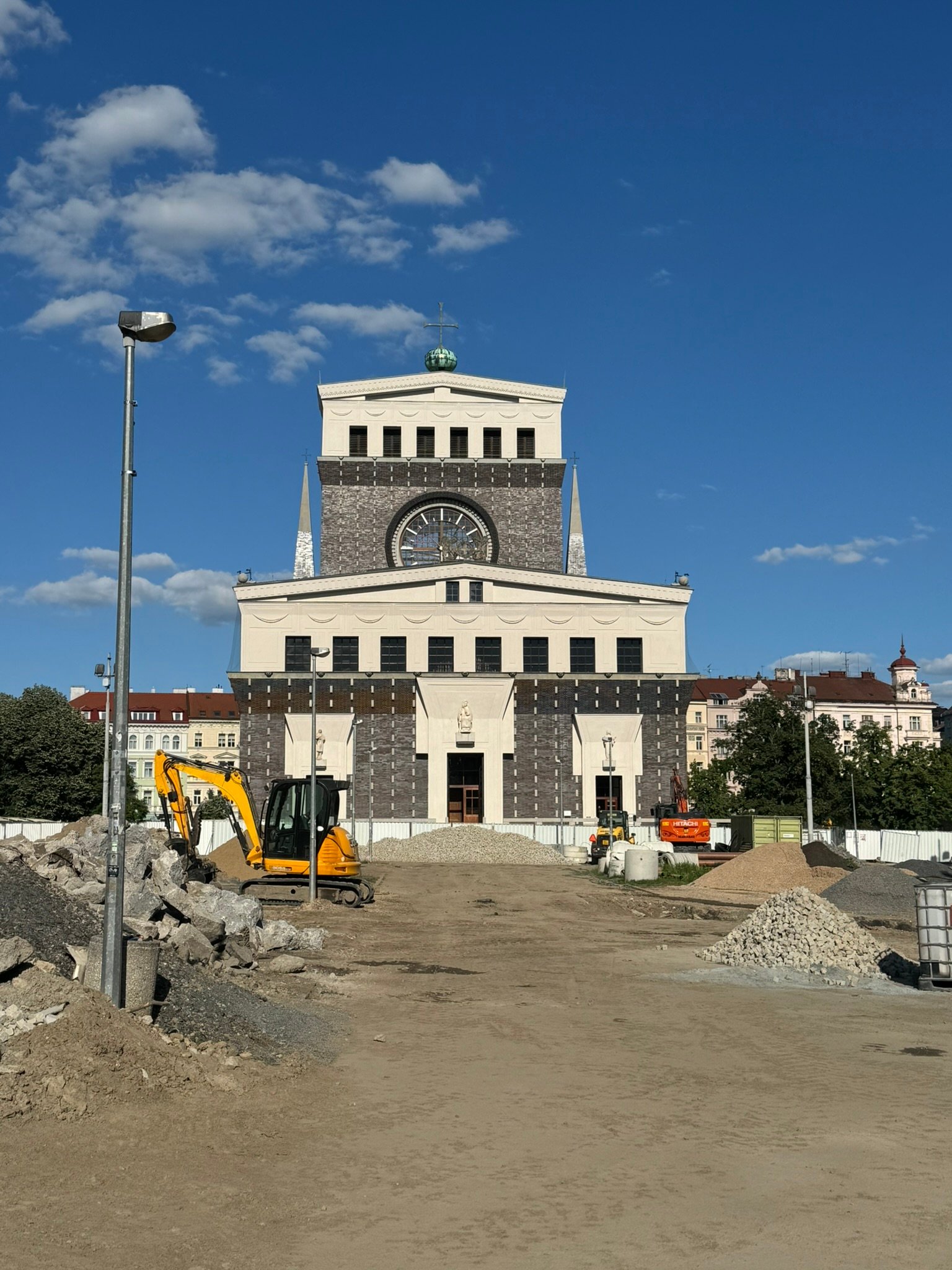
The Church of the Most Sacred Heart of Our Lord offers a striking change of architectural language. A large circular clock is set into a broad tower, above a front that feels compact and monumental. In this photograph, construction materials and machinery occupy the foreground. They are part of the scene as recorded, rather than evidence that the church normally stands within a finished, empty plaza.
Designed by Slovenian architect Jože Plečnik, the church was built from 1928 to 1932. Its distinctive use of mass, brickwork and a great round clock brings a twentieth-century interpretation to religious architecture. The building demonstrates how Prague’s identity extends beyond the Gothic and Baroque landmarks most frequently associated with its centre.
The nearby Žižkov Television Tower moves the visual story further toward engineering and communications. Designed by Václav Aulický and Jiří Kozák, the 216-metre structure entered service in 1992. In the photographs, its projecting capsules rise above neighborhood façades and trees. One view situates it beside yellow residential buildings; another gives it more open sky. Together, they show a modern landmark becoming part of the same habit of looking upward that the older towers encourage.
Doors, Street Patterns and Small Discoveries
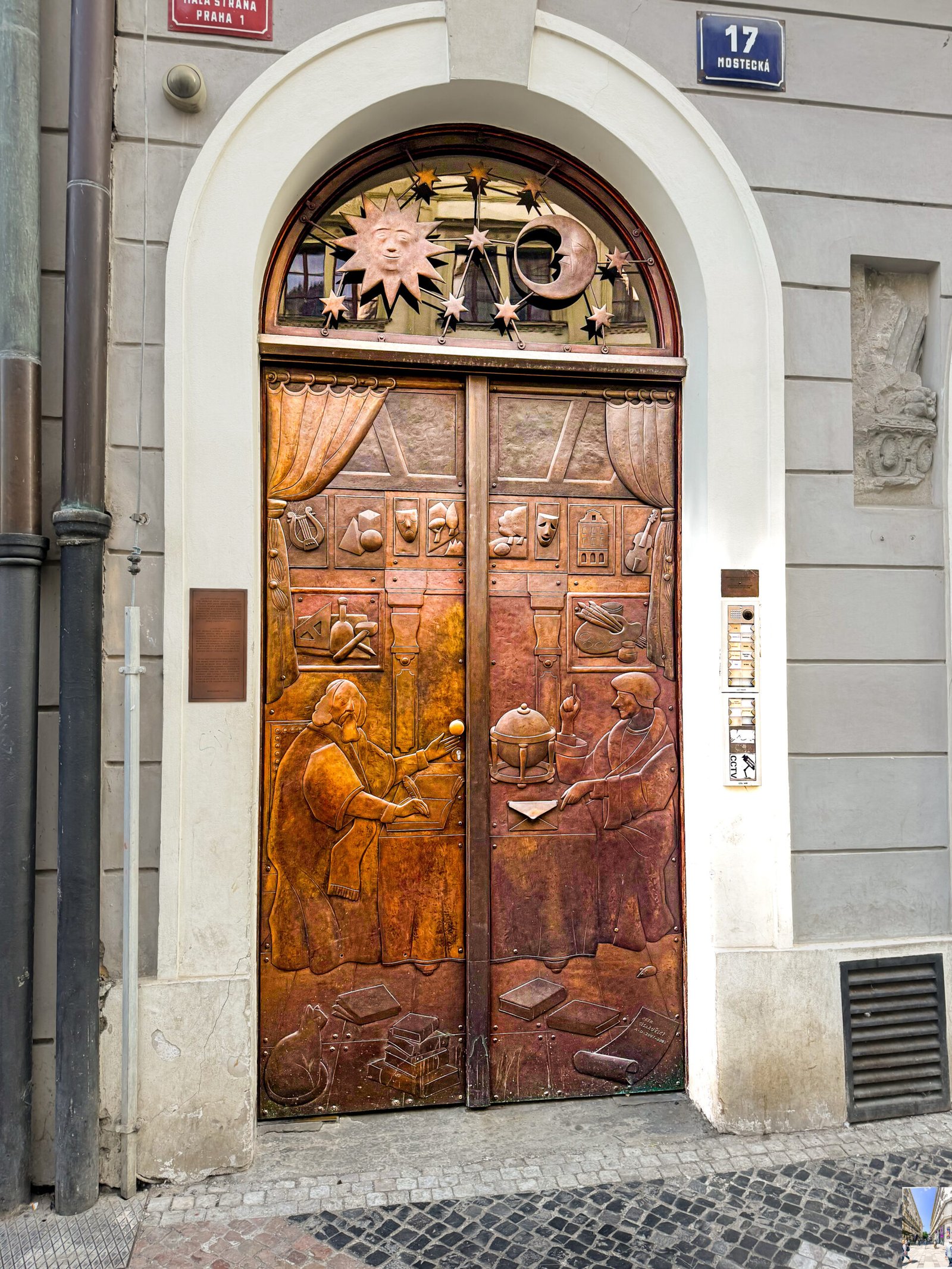
Between the major buildings are details that reward a slower pace. The carved wooden doors in this collection have their own composition: panels of relief carving below, a decorated curved opening above, and a pale stone surround that sets off the warmer wood. The image does not need a large square or distant skyline to convey the pleasure of looking closely.
The street photographs perform a similar task. Repeated paving stones lead toward a bend or a distant tower; shopfronts and parked vehicles interrupt the line; pedestrians provide a changing foreground. These elements are sometimes treated as distractions from architectural photography, but here they also describe the city’s working surface. They show how a grand façade is approached on foot and how an old street accommodates contemporary movement.
A red vintage car displayed indoors supplies a final change of subject. Its polished body, bright wheels and curved fenders offer a different kind of design study from the surrounding architecture. The photograph is included as an observed object, without assigning an unverified model, year or exhibition venue. That restraint leaves room for the image’s strongest qualities: color, shape and the reflections of the space around it.
Prague After the Lamps Come On
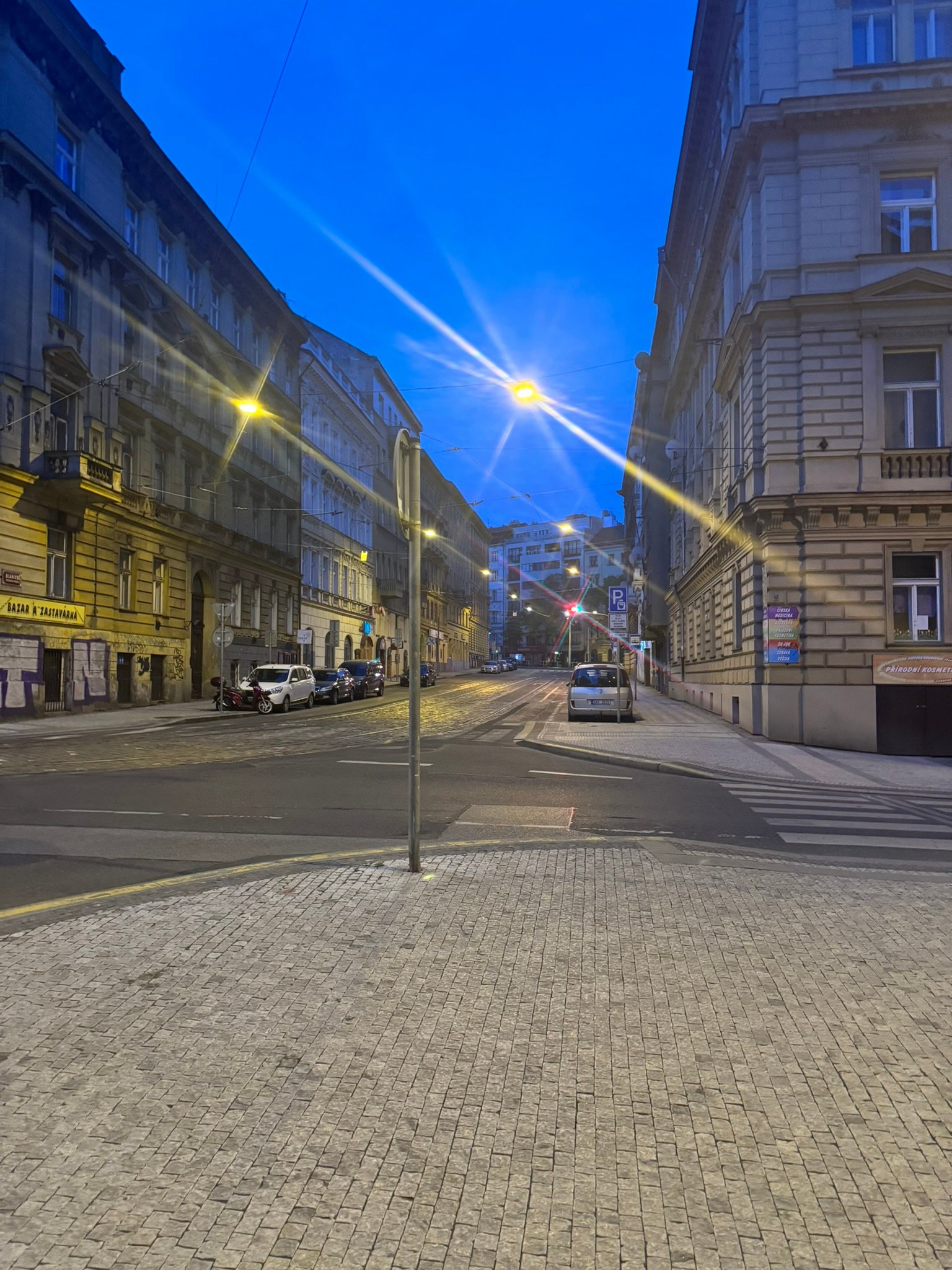
Several images return to the transition between daylight and darkness. Warm lamps form small starbursts against a blue sky; building edges become simpler silhouettes; pale walls pick up concentrated patches of illumination. The quieter intersections invite attention to things that can disappear inside a busy daytime scene, including the pattern of a crossing or the curve of a corner façade.
The church with twin spires and the illuminated theatre give the selection two different nighttime moods. One is dominated by dark vertical forms; the other by a lighted public frontage. The street scenes connect them through repeated pools of warm light. Seen together, the photographs make a sequence of changing illumination rather than a strict reconstruction of a single walk.
This collection brings Prague into view through nineteen individual frames, moving from broad civic monuments to neighborhood streets and small decorative details. Its continuity comes from recurring forms: towers above roofs, carved surfaces, patterned ground and the changing balance of light and stone. The gallery preserves the complete approved selection, while the larger photographs within the article invite a slower look at a few of its central subjects.
Historical Sources
UNESCO — Historic Centre of Prague
Prague City Tourism — Powder Gate Tower
Prague City Tourism — Charles Bridge
Radio Prague International — History of the Prague Orloj
Prague City Tourism — Vinohrady Theatre
Prague City Tourism — National Museum
Prague City Tourism — Church of the Most Sacred Heart of Our Lord