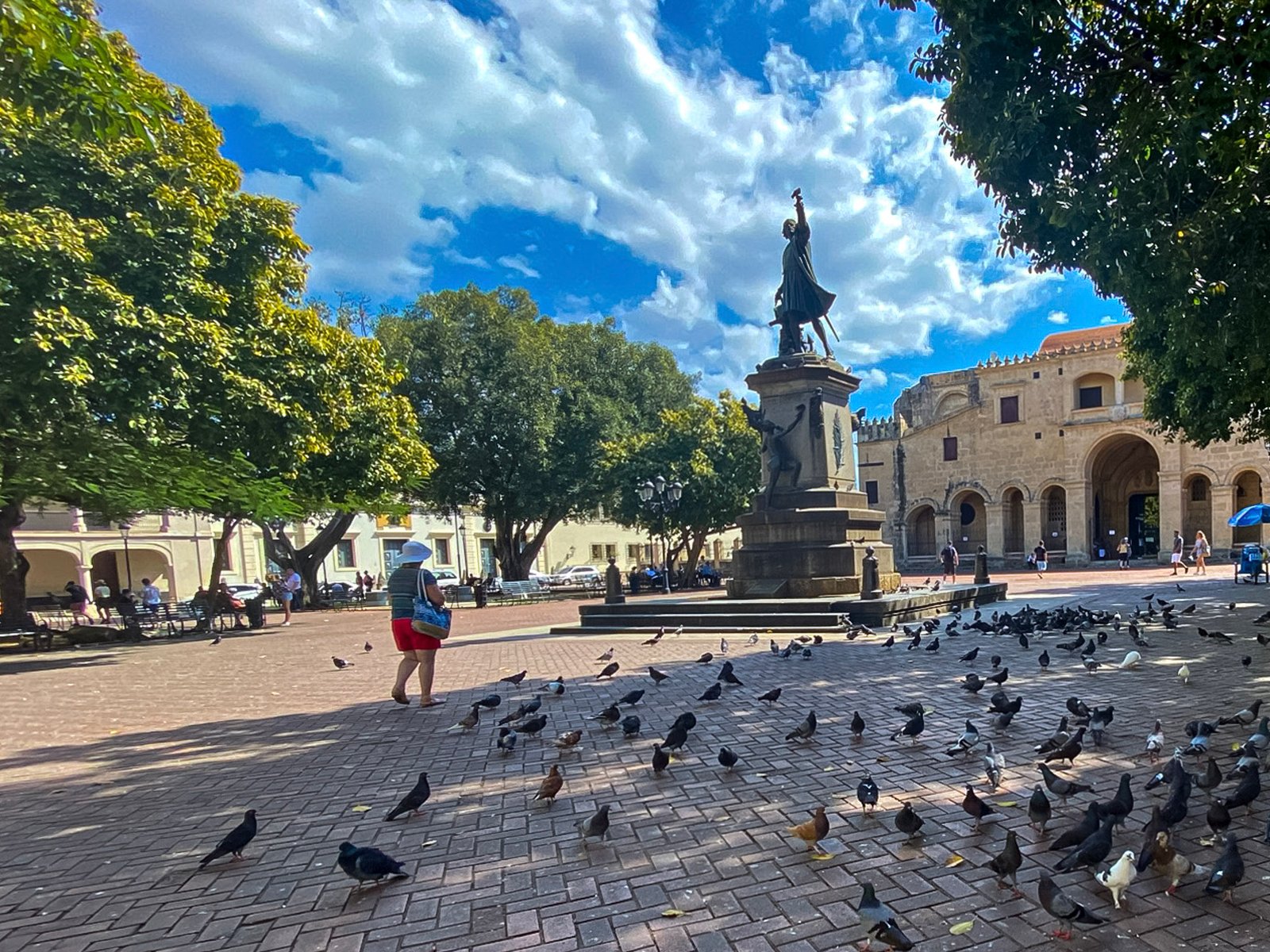
Wider view of the San Francisco ruins and surrounding street.
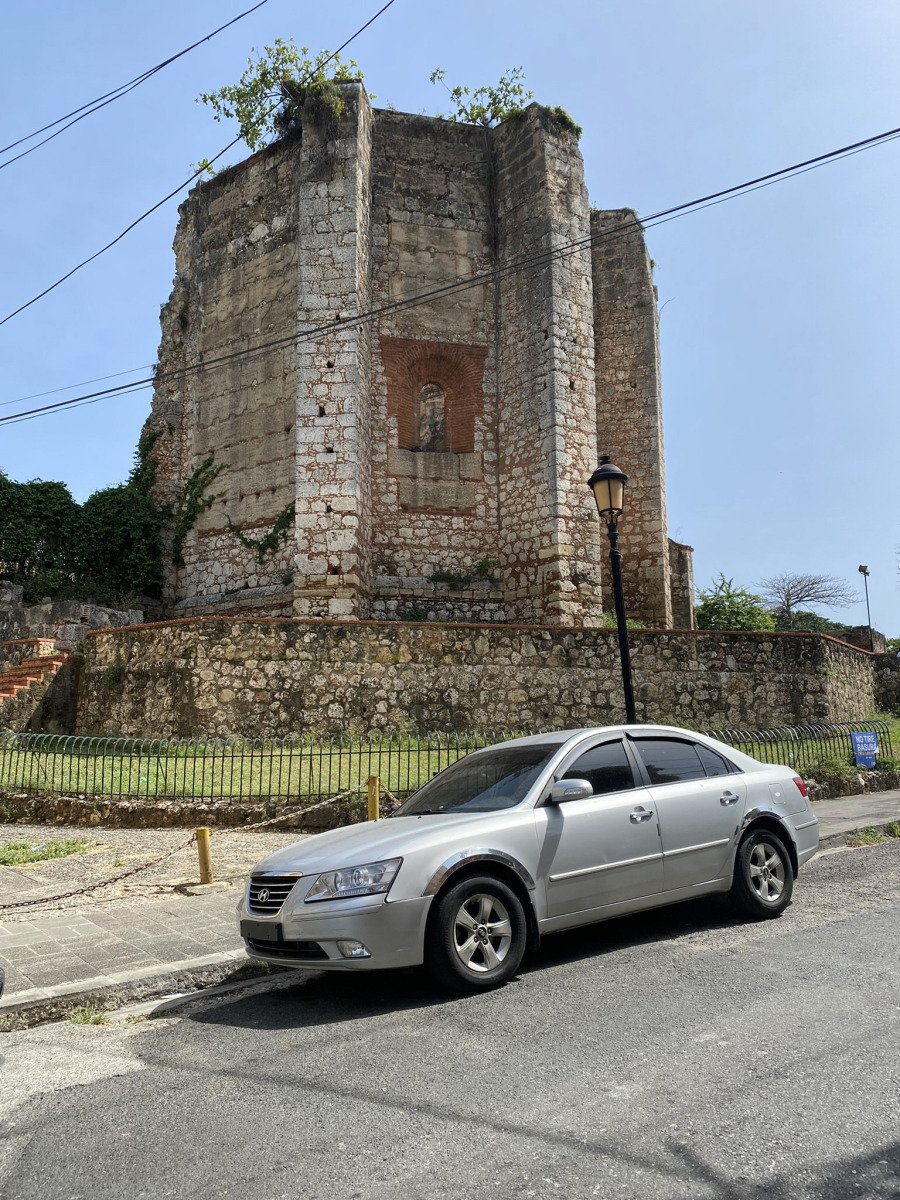
Wider view of the San Francisco ruins and surrounding street. Photography by A. Abbady.
Santo Domingo reveals itself through contrasts: pale stone beside painted walls, elaborate iron balconies above parked cars, a bright Caribbean sky followed by a bank of dark clouds. This photographic journey concentrates on the built environment of the Colonial City. The buildings are the subjects, but the streets around them remain part of a working capital. Wires, signs, delivery vehicles and changing light belong to the view as surely as the monuments.
The collection brings together twenty-four photographs, including alternate viewpoints that reveal small changes in framing and detail. A gateway introduces national memory; cathedral walls give a sense of architectural weight; a ruined religious complex exposes the structure beneath a finished building. Between these landmarks, ordinary streets show the smaller patterns that make a city recognizable. These photographs record a visit, rather than a complete inventory of Santo Domingo’s heritage.
A City Planned Beside the Ozama
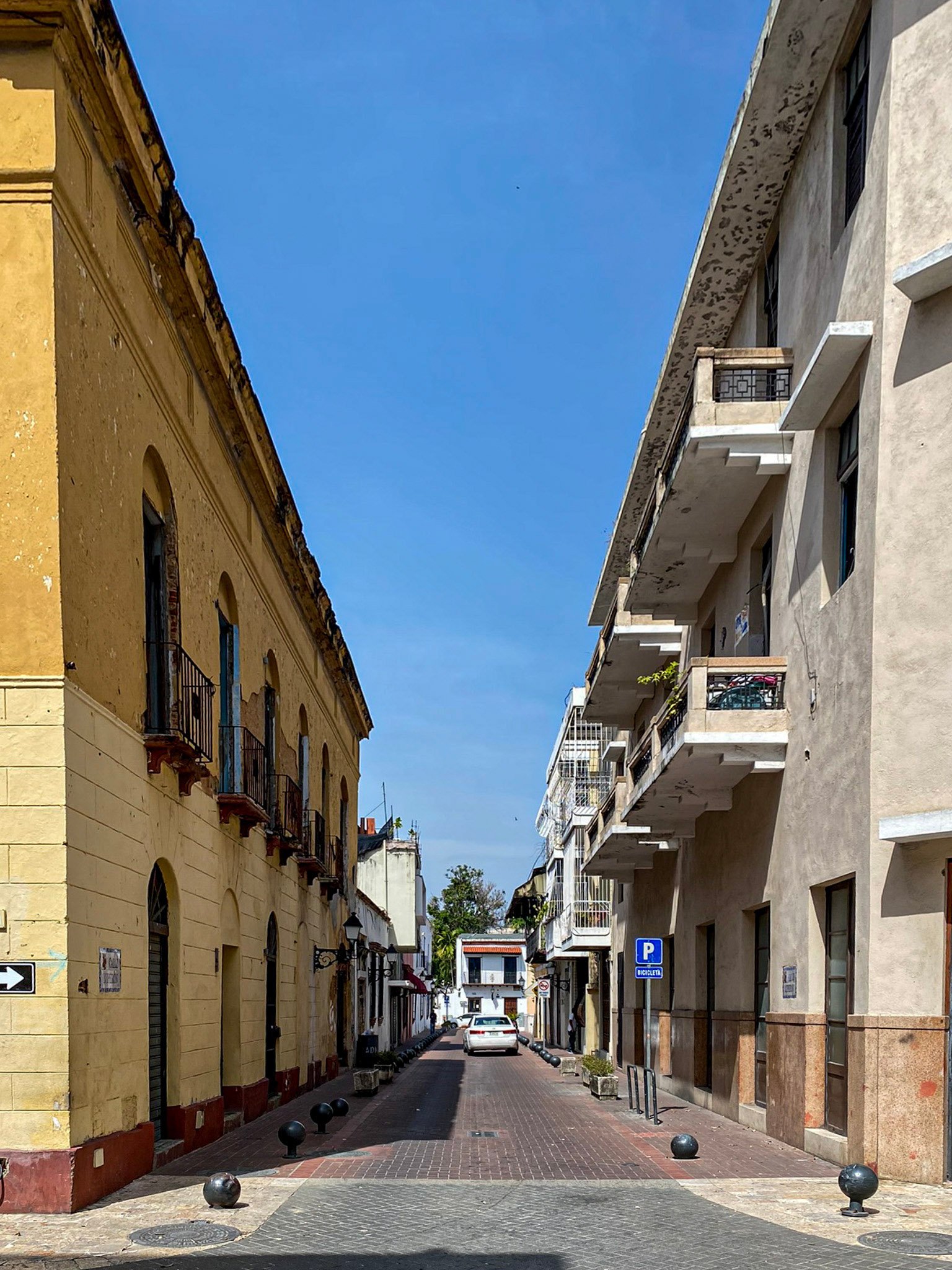
Santo Domingo’s colonial settlement developed on the Ozama River, with its institutions transferred to the west bank under Nicolás de Ovando in 1502. UNESCO describes the regular street grid and central plaza as influential models for later cities in the Americas. The Colonial City entered the World Heritage List in 1990. Its importance lies both in individual monuments and in the survival of relationships between streets, public spaces and buildings. [1]
That history also belongs to European conquest and colonial rule, rather than simply to a catalogue of architectural achievements. A balanced reading should recognize that Hispaniola already had Indigenous communities before Europeans arrived. The familiar tourism language of colonial “firsts” describes European institutions established in the Americas; it does not describe the beginning of civilization or settlement on the island. [1]
The photographs make the street network tangible. Walls converge toward a distant junction, while balconies project over narrow corridors of shade. Looking along a street explains the scale of the district differently from looking at a single façade. There is a rhythm of openings, corners and interruptions. Even where the destination at the end of the view is unclear, the route itself becomes the subject.
The Cathedral: Weight, Texture and Changing Light
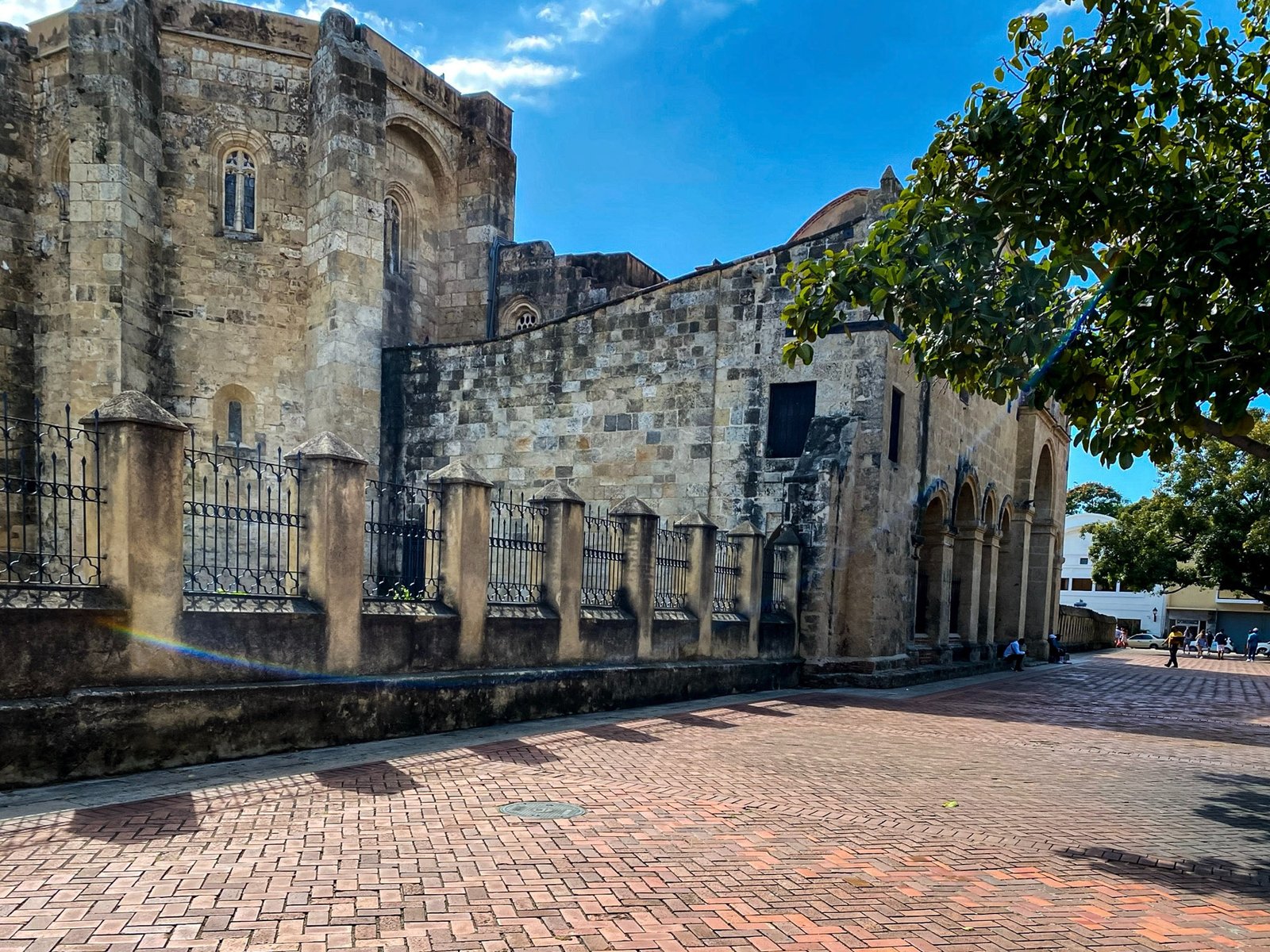
The Cathedral of Santa María de la Encarnación is one of the Colonial City’s defining monuments. Its early-sixteenth-century architecture combines late Gothic character with Renaissance elements, a transition UNESCO specifically identifies as significant. [1] The Dominican tourism ministry’s architectural overview places its construction in the sixteenth century and emphasizes the combination of Gothic form and Renaissance detail. [2]
The selected side view concentrates on the stonework rather than treating the cathedral as a distant backdrop. The wall rises in broad planes, punctuated by narrow windows and arched openings. Changes in color between individual blocks give the surface a depth that a smooth painted wall would not have. Ironwork in front introduces a finer, repeated pattern against the large masonry forms.
Light is especially important here. Strong sun makes the wall feel substantial, while the deep shadows around openings reveal the thickness of the construction. The foliage in the upper corner softens the outline. A visible lens flare is part of the original photograph, recording the relationship between the camera and the bright sun. The scene is preserved rather than reconstructed into an idealized architectural rendering.
Puerta del Conde: A Threshold in National Memory
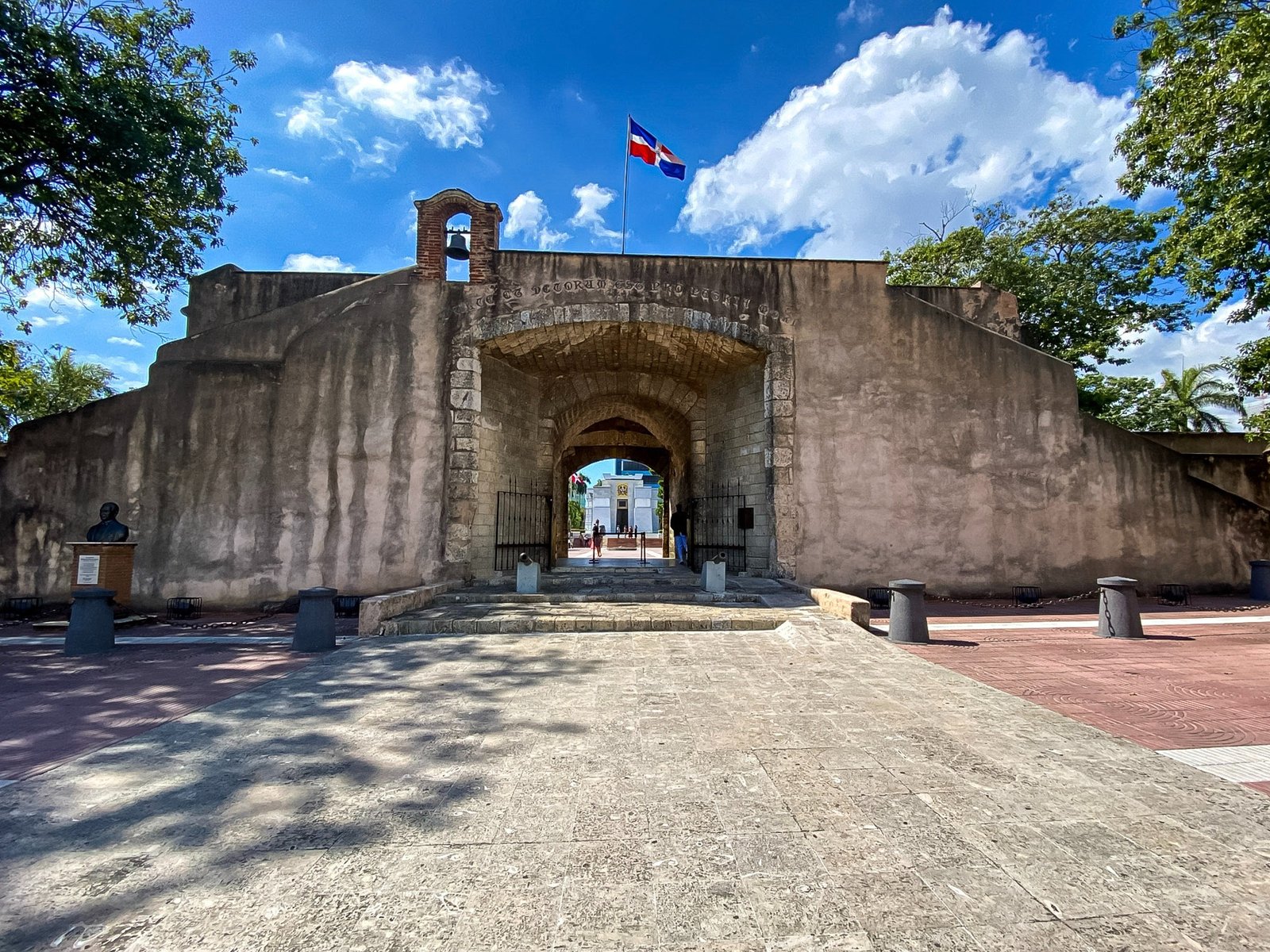
Puerta del Conde connects the history of the old city’s defenses with the history of Dominican independence. The Ministry of Tourism identifies it as part of the former defensive entrance and as the place associated with Francisco del Rosario Sánchez raising the Dominican flag and proclaiming independence on February 27, 1844. Its name honors the Count of Peñalba, linked to the successful defense of Santo Domingo against an English attack in 1655. Today it provides an entrance to Parque Independencia. [3]
In the photograph, the opening works as a frame inside a frame. The heavy outer wall surrounds the darker passage, and a further view appears beyond. The flag introduces movement above an otherwise solid composition. The broad foreground and its tree shadows make the gate feel connected to the public space around it, rather than isolated as an object.
The wall’s weathered surface deserves attention. Stains and uneven tones prevent the gateway from looking newly manufactured. They also remind the viewer that a monument is maintained through time, exposed to sun and rain, and repeatedly encountered by people passing through. The picture brings together a national symbol and an everyday route without suggesting that the present appearance is unchanged from 1844.
San Francisco: Reading a Building Through Its Ruins
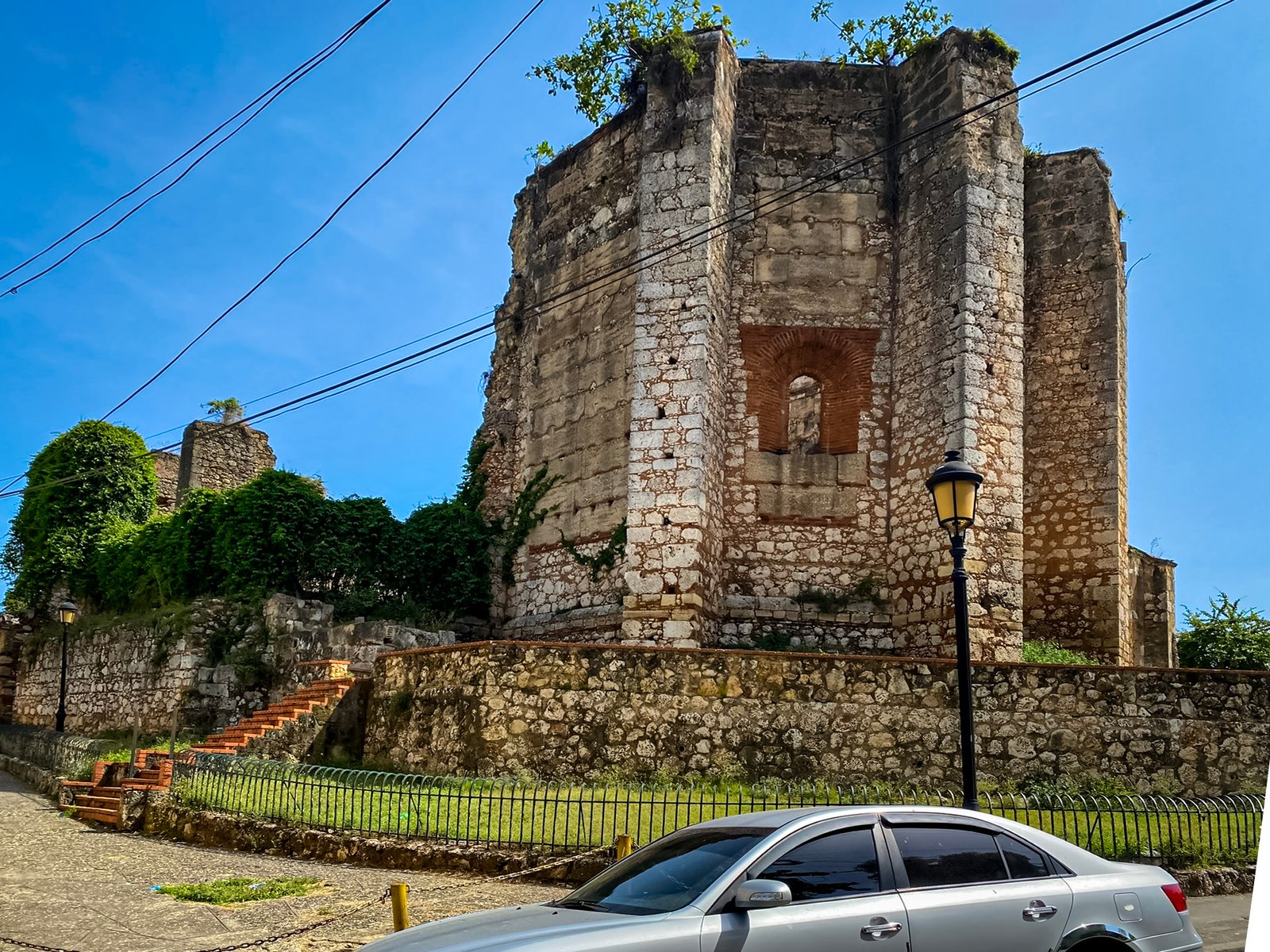
The remains of the San Francisco religious complex offer a different experience from a standing cathedral. An architectural history published by the Dominican Republic’s Academy of Sciences describes a complex that included church, convent and cloister, the Third Order church, gardens and water infrastructure. Its early structures were vulnerable to tropical weather, and the surviving ruins reflect a long history of construction and alteration rather than a single untouched building. [4]
The chosen photograph emphasizes a tall masonry section with strong vertical supports and a recessed brick arch. Without a roof or complete interior enclosing the view, edges and thickness become unusually visible. Vegetation at the top and along the lower structures adds another layer: living growth occupies the spaces where the architecture has opened to the weather.
The foreground remains recognizably urban. A streetlamp, overhead wires, fence and part of a parked vehicle place the ruins within today’s city. These details are retained deliberately. Removing them would create a tidier image, but would also suggest a separation between monument and neighborhood that the photograph does not show. The scene records heritage sharing space with ordinary infrastructure.
The Academy’s discussion also emphasizes the importance of protecting the complex from invasive intervention. [4] For a photographer, that supports a simple distinction: the image can invite close attention without treating a fragile historic structure as something to climb, rearrange or use merely as a backdrop.
Balconies, Painted Walls and the Everyday Street
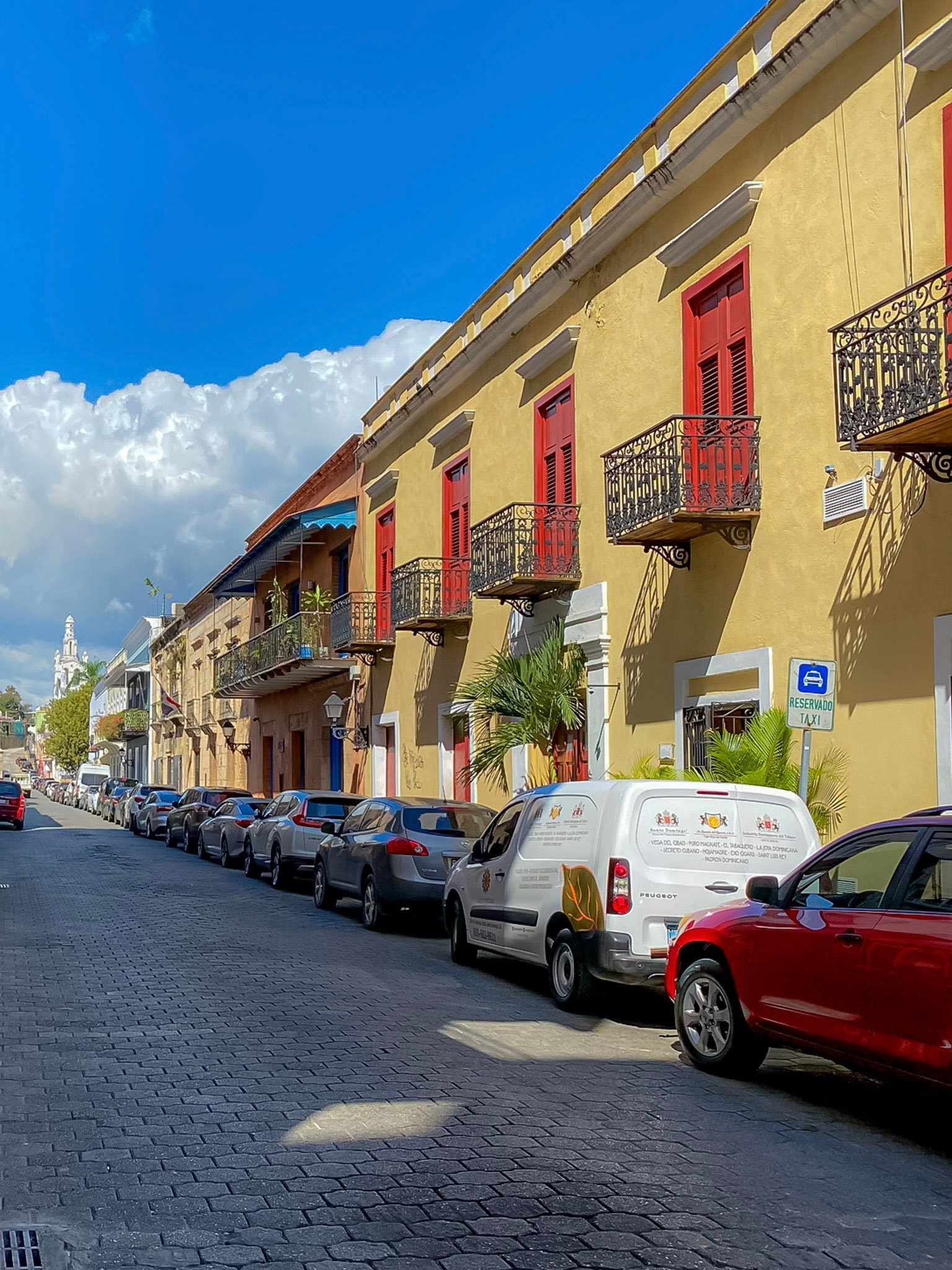
Not every memorable view needs a major monument. In one frame, red doors and dark iron balconies repeat across a yellow façade. Their shadows fall diagonally down the wall, creating a second version of the ironwork beneath the real structure. The blue sky strengthens the warm wall color, while the line of parked vehicles brings the composition back to street level.
Another view looks between a yellow building and a paler modern façade. The two sides have different window and balcony patterns, yet both guide the eye toward the distance. It is tempting to label every attractive building in a historic district “colonial,” but a photograph alone cannot establish its construction date. These captions therefore describe visible architectural features without assigning an unsupported age to individual houses.
Together, the street photographs show why the Colonial City is experienced through walking as well as through landmark visits. A single façade may reward a pause, but a longer view reveals how adjacent buildings relate. The repetition is never perfect: a balcony projects farther, a wall changes color, a tree interrupts the line, or a sign introduces a contemporary need. Those variations give the streets their visual texture.
The Clock Tower and the View Toward Parque Colón
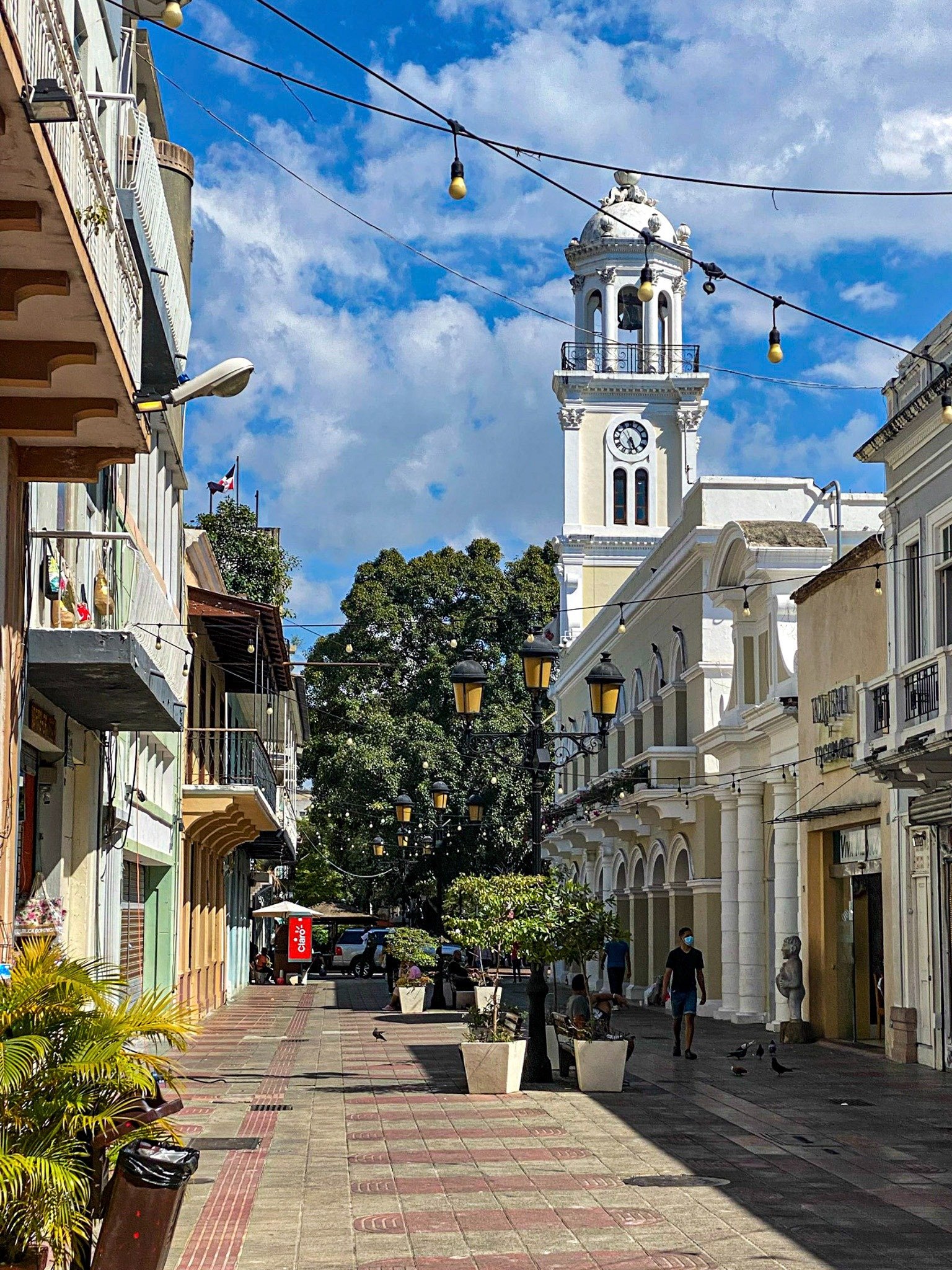
The white clock tower of the Palacio Consistorial provides a vertical accent above the street near Parque Colón. Its present appearance reflects later architectural changes, so it should not be treated as an entirely sixteenth-century structure. A historical account by architect Omar Rancier describes the building’s transformation from a colonial house into its more elaborate civic form. [5]
Parque Colón itself developed from the old Plaza Mayor and remains closely associated with the cathedral and surrounding streets. The Dominican film commission describes the square’s historic setting and its relationship to El Conde and Isabel la Católica. [6] In the selected view, hanging light strings, streetlamps and balconies lead toward the tower, linking civic architecture with the scale of the pedestrian street.
The tower is also a useful example of layering. Its pale surfaces and decorative upper stage do not need to resemble the cathedral’s heavy masonry to belong to the same city. Their difference is part of the story. A historic district contains buildings and alterations from more than one period, and its appearance is richer when those distinctions remain visible.
When the Sky Changes the Street
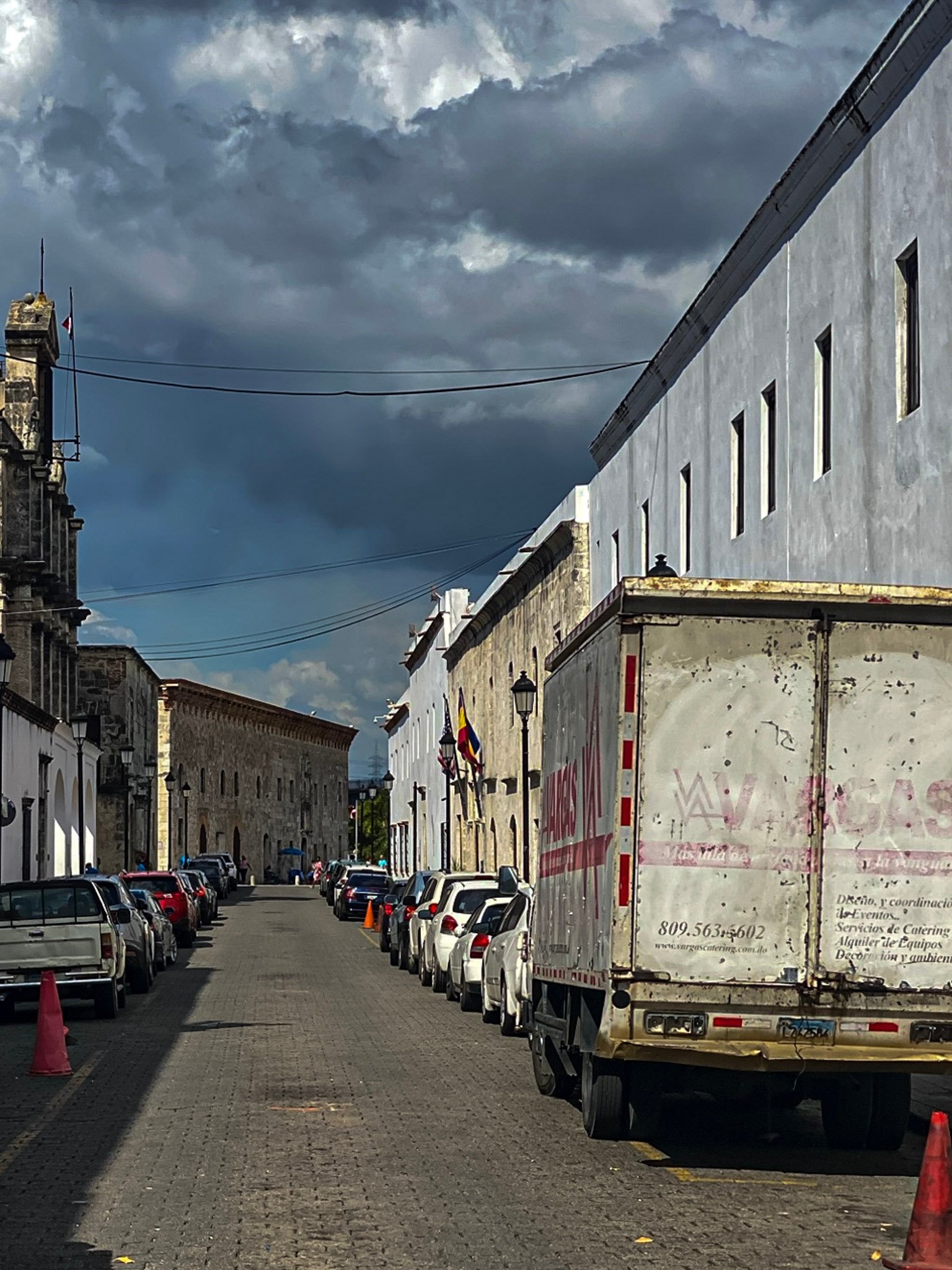
The darker street photograph changes the mood of the collection. Dense clouds gather above pale walls, while a delivery truck occupies much of the foreground. The contrast draws attention upward, then returns the eye to the road. Here the atmosphere is as important as the architecture.
The photograph does not establish that a storm followed, and it does not need an invented account of what happened next. What it records is enough: a moment of dark sky, strong architectural lines and ordinary city traffic. Keeping that uncertainty preserves the distinction between what an image shows and what a storyteller might imagine.
Seen together, these views present Santo Domingo through stone, color and daily use. The gate, cathedral and ruins carry different histories; the streets connect them through a shared visual language of shade, openings, balconies and changing weather. The result is an invitation to look carefully at the city’s layers, with its monuments understood as part of a living urban setting.
Original photography by A. Abbady.
Historical Sources
[1] UNESCO World Heritage Centre, Colonial City of Santo Domingo: https://whc.unesco.org/en/list/526/
[2] Dominican Republic Ministry of Tourism, Santo Domingo destination brochure: https://assets.simpleviewinc.com/simpleview/image/upload/v1/clients/dominicanrepublic/santo_domingo_brochure_2020_1__2a1d8043-e6c9-463c-8b58-8bbde89b1d13.pdf
[3] Dominican Republic Ministry of Tourism, Puerta del Conde: https://es.godominicanrepublic.com/que-hacer/puerta-del-conde
[4] Academia de Ciencias de la República Dominicana, Importancia histórica y arquitectónica del convento de los frailes de San Francisco: https://www.academiadecienciasrd.org/importancia-historica-y-arquitectonica-del-convento-de-los-frailes-de-san-francisco-de-la-ciudad-de-santo-domingo/
[5] Omar Rancier, Palacio Consistorial, 1906, Diario Libre: https://www.diariolibre.com/revista/cultura/palacio-consistorial-1906-AA8839121
[6] Dirección General de Cine, Parque Colón: https://dgcine.gob.do/locaciones/locacion/parque-colon/