About these images: This gallery presents AI-assisted artistic edits of A. Abbady’s original travel photographs, with adjusted framing, light and color. Fine details may differ from the original scenes. The historical text describes the real landmarks; these edited images are interpretive views. Prints are not currently offered from this collection.
The Neue Burg wing of the Hofburg across a lawn — AI-assisted edit
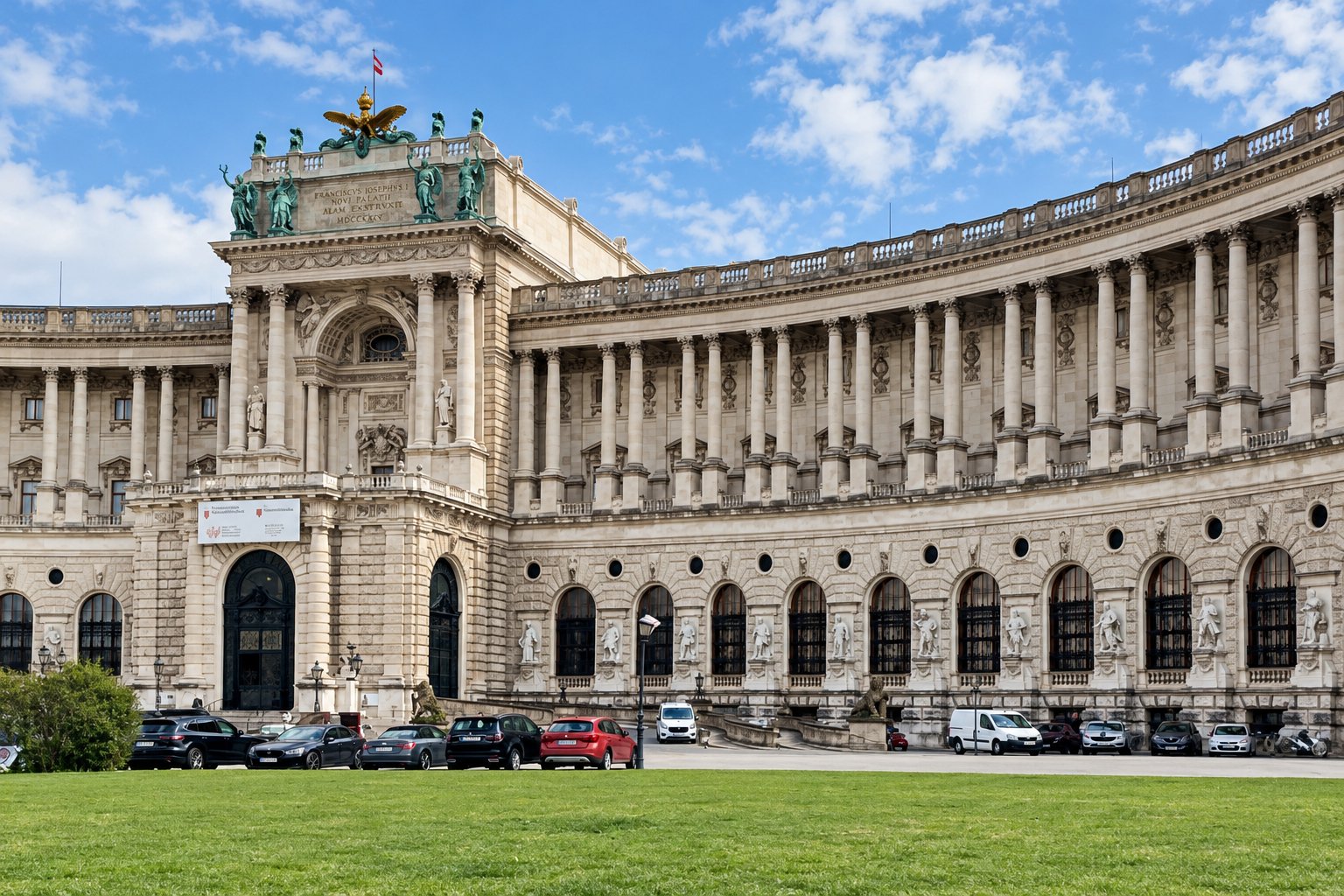
The Neue Burg wing of the Hofburg across a lawn. AI-assisted artistic edit of A. Abbady’s travel photograph; fine details may differ from the original scene.
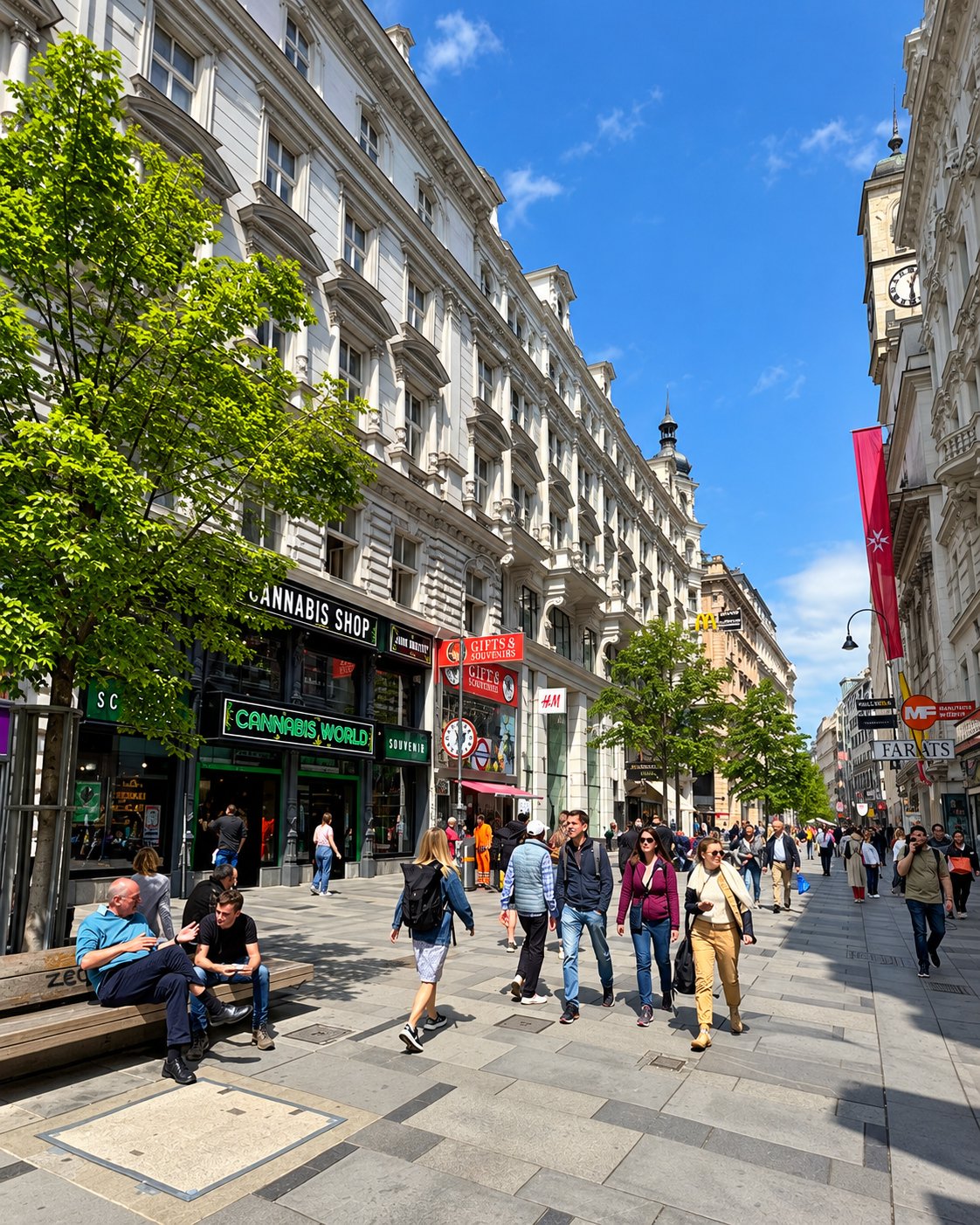
Vienna reveals its scale gradually. A narrow lane directs the eye between pale façades; a busy shopping street opens into a cathedral square; a broad lawn allows a palace frontage to spread across the horizon. These thirteen photographs follow that change of scale, moving between the everyday city and its great ceremonial spaces. They preserve pedestrians, traffic, signs and temporary barriers alongside the architecture, keeping the images connected to the moment in which they were made.
The Historic Centre of Vienna is recognized by UNESCO for an urban ensemble shaped particularly by its medieval, Baroque and nineteenth-century development. These periods are experienced together in the present city rather than as separate chapters behind museum glass. A person walking through the centre can pass from an older street pattern into a much wider space without a sharp boundary announcing the change.
In this selection, the photographs are the starting point. The history explains the buildings and spaces that appear, while the images retain the incidental details that make them personal observations of travel. No interior visit is implied by an exterior view, and the sequence is arranged by subject rather than presented as a verified reconstruction of one continuous walk.
St Stephen’s Cathedral: Many Centuries in One Building
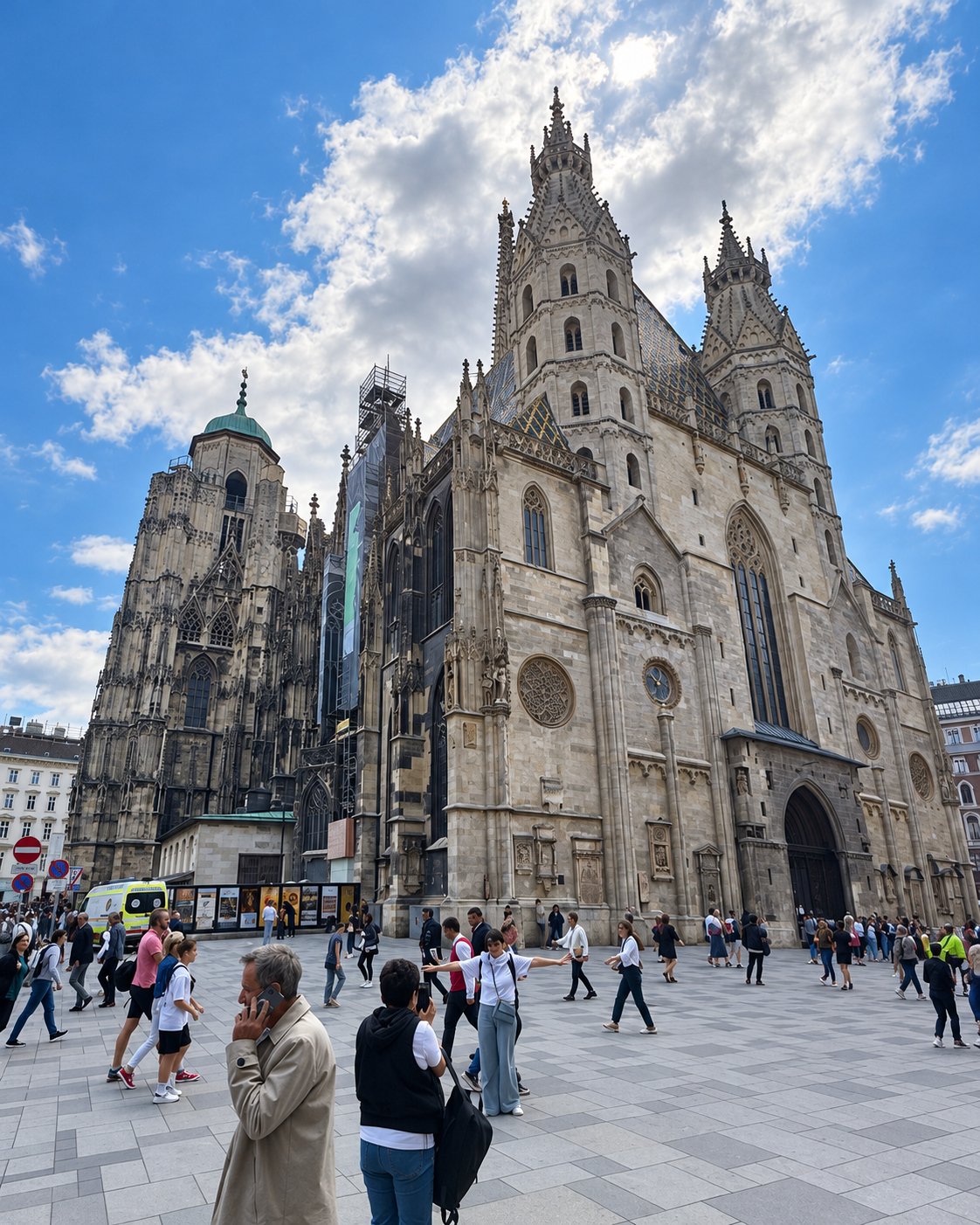
St Stephen’s Cathedral dominates two photographs in different ways. One emphasizes the height of the building against a bright, clouded sky; the other gives a clearer view of the west front, its great doorway and flanking towers. The surrounding people help establish its scale. The cathedral is monumental, but the ground around it remains a place of meeting, movement and everyday conversation.
The earlier Romanesque church was consecrated in 1147. Later medieval rebuilding gave St Stephen’s much of its Gothic character, including the celebrated South Tower, whose construction began in 1359. The west front preserves an older architectural language alongside the later fabric. The building is therefore better understood as the work of successive generations than as the product of a single design campaign.
The patterned roof gives the photographs another strong surface to explore. Its angled geometry contrasts with the upright stonework, while the small details of tracery and sculpture slow the eye. The different views make clear why one picture rarely describes a large church completely: an angle that reveals the long roof may conceal part of the façade, while a frontal position changes the balance again.
Stephansplatz: Architecture and the Moving Crowd
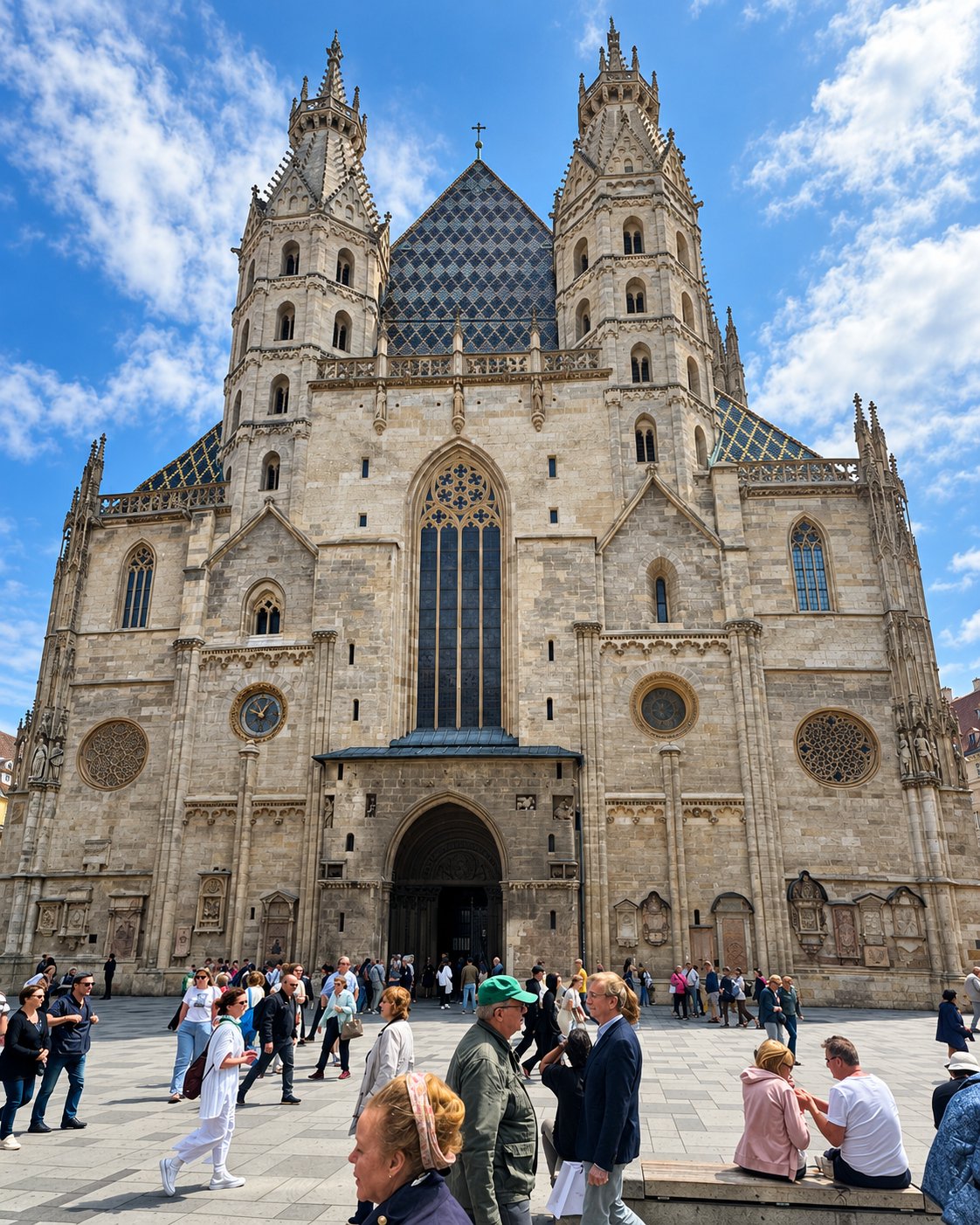
The square around the cathedral makes a useful counterpoint to its apparent permanence. People walk toward the doors, stand beside one another, or cross the foreground on their way elsewhere. Their positions will change seconds after the exposure, while the great architectural forms remain. That combination gives a travel photograph both its recognizable subject and its particular moment.
St Stephen’s also carries a history of loss and rebuilding. Severely damaged in the Second World War, it was restored in the postwar years, with a major reopening in 1952. The standing building thus records acts of repair as well as medieval ambition. Its appearance should not be mistaken for evidence of an entirely untouched past.
The photographs stay outside, where the church and the square can be read together. Pale paving fills much of the foreground, giving the clustered figures space around them. Bright sky and strong light make some stone details less distinct, but also preserve the atmosphere of the scene. The two selected views receive separate edits, allowing the reader to compare different compositions of the same building.
Streets Between the Landmarks
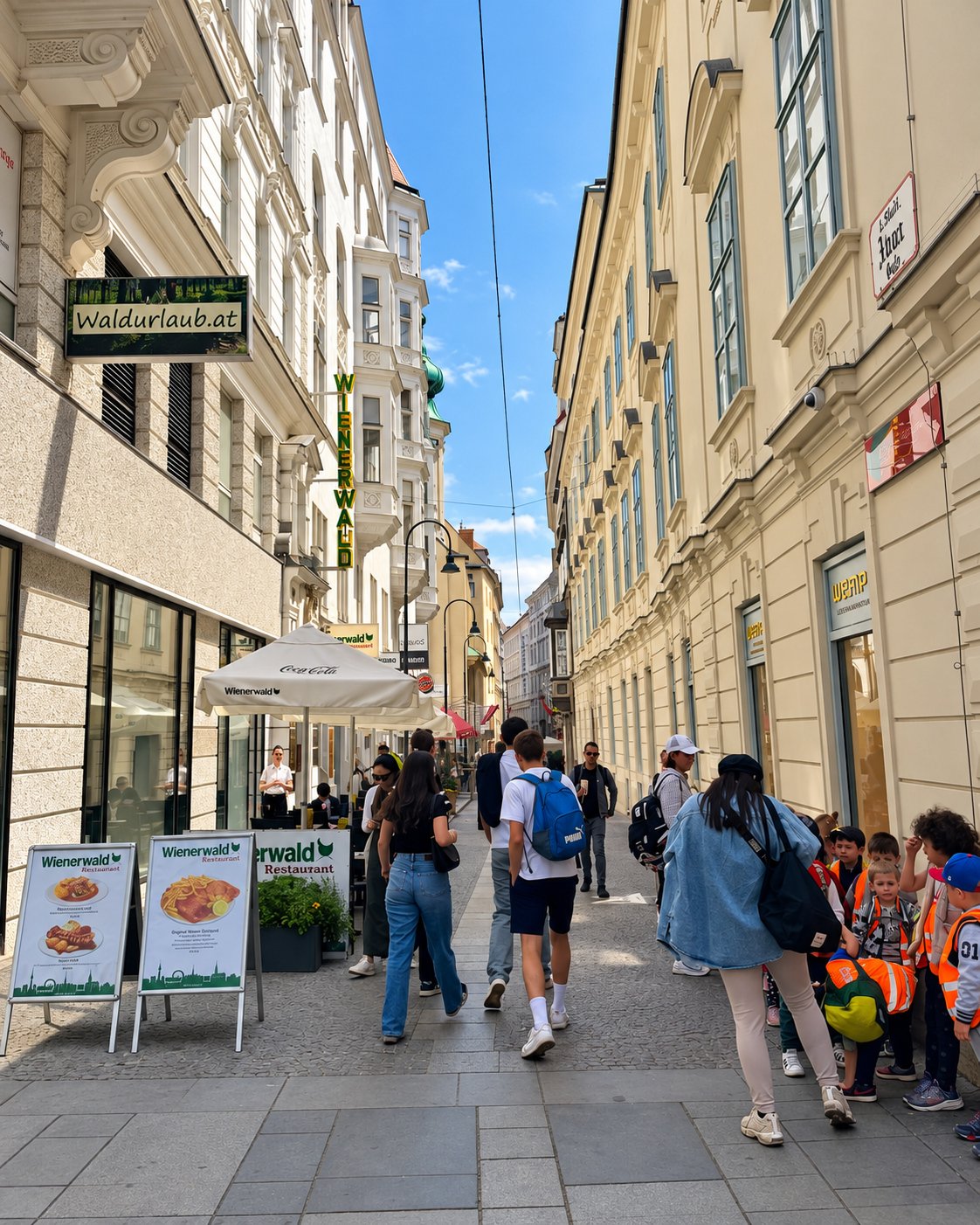
The narrow street photograph creates depth through repetition. Windows, stone courses and shopfronts move away toward a distant opening, while pedestrians occupy the corridor between them. Unlike the cathedral square, this view offers little open foreground. Its interest comes from compression: buildings face one another closely, and the sky becomes a thin shape above the route.
The wider pedestrian scenes offer another rhythm. Trees break the line of the façades, awnings and commercial signs sit below older upper storeys, and paving patterns guide movement across the frame. An ice-cream display outside a shop is as much a record of the photographed street as the ornamental architecture beyond it. The mixture is part of what makes an urban walk different from viewing isolated monuments.
These pictures invite a slower kind of attention. A corner building can become a pivot in the composition; a dark shopfront can balance a sunlit wall; a person crossing the scene can briefly separate two otherwise continuous surfaces. Such details do not require elaborate historical claims to matter. They show how the centre works at human scale, connecting the major sites through spaces that people actually use.
The Ringstrasse and a City Replanned
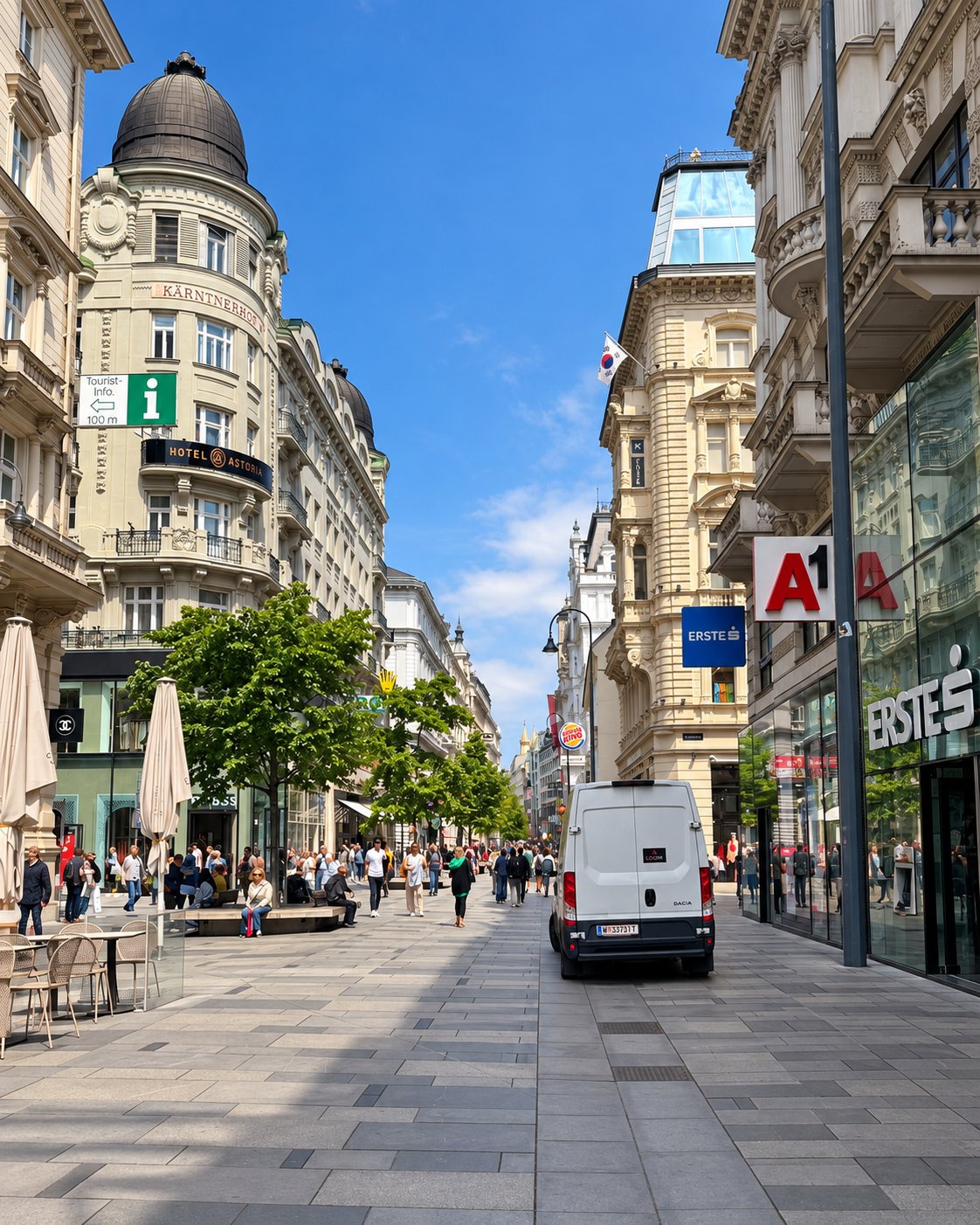
Vienna’s expansive public architecture has an important nineteenth-century context. In 1857, Emperor Franz Joseph ordered the removal of the fortifications around the inner city. The land made available supported the development of the Ringstrasse, with major public institutions, residences and open spaces taking shape over the following decades. The boulevard was officially opened in 1865, although much of the surrounding construction continued afterward.
Historicism was central to this transformation. Architects drew on earlier styles to give new institutions an established visual authority. Renaissance, Gothic and other architectural languages could be used in buildings serving modern nineteenth-century purposes. As a result, a façade that feels old does not always belong to the period it evokes.
The photographs here show the larger urban contrast that helps explain this history, without assigning every street view to the Ringstrasse itself. Dense commercial streets and broad monumental settings create different conditions for the camera. One rewards a vertical frame filled with detail; the other needs breathing room for lawns, sky and long façades. The collection gains variety by keeping both kinds of space in view.
Maria Theresa and the Museum Square
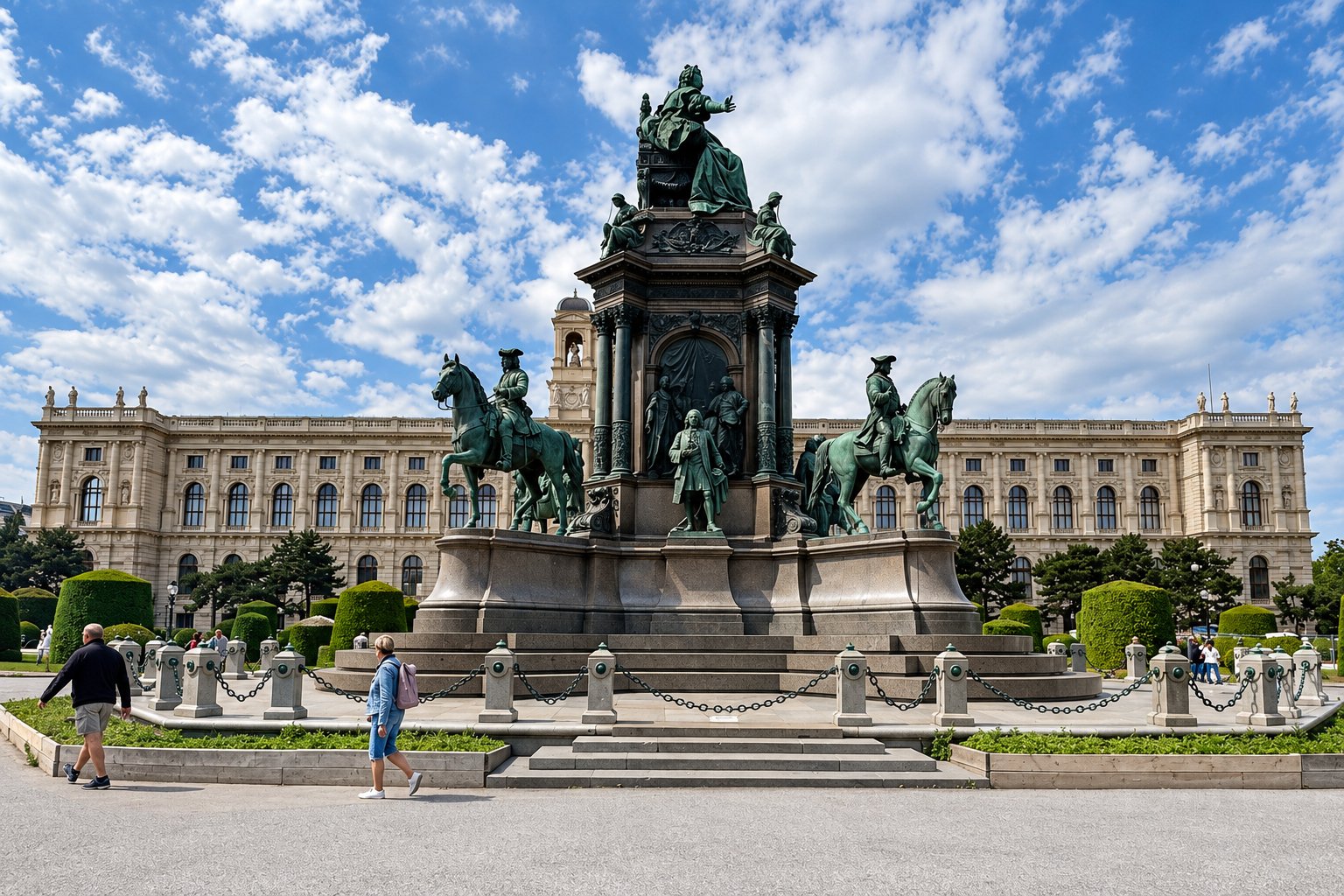
The Maria Theresa Monument rises from a substantial base surrounded by sculptural groups. In the photograph, the central figure is set against bright clouds, with a museum extending behind it. The monument is approached across an open foreground, so its mass can be understood before the viewer begins to examine individual figures. Bronze and stone work together to establish a clear centre within the square.
Maria-Theresien-Platz lies between the museums of art and natural history. Its arrangement formed part of the ambitious Imperial Forum project associated with the wider expansion around the Hofburg. The monument was designed by Kaspar von Zumbusch and unveiled in 1888. Its programme places the ruler within a larger representation of military, administrative and cultural achievement.
That setting matters as much as the statue alone. The museums provide long architectural edges, while paths and planting organize the approach. The photograph lets the viewer see a monument as part of a planned public composition. It is a place designed to frame memory, with the surrounding institutions giving that memory an educational and cultural setting. The modern visitors in the foreground introduce another scale into the official presentation.
Museum Architecture and the Public Collection
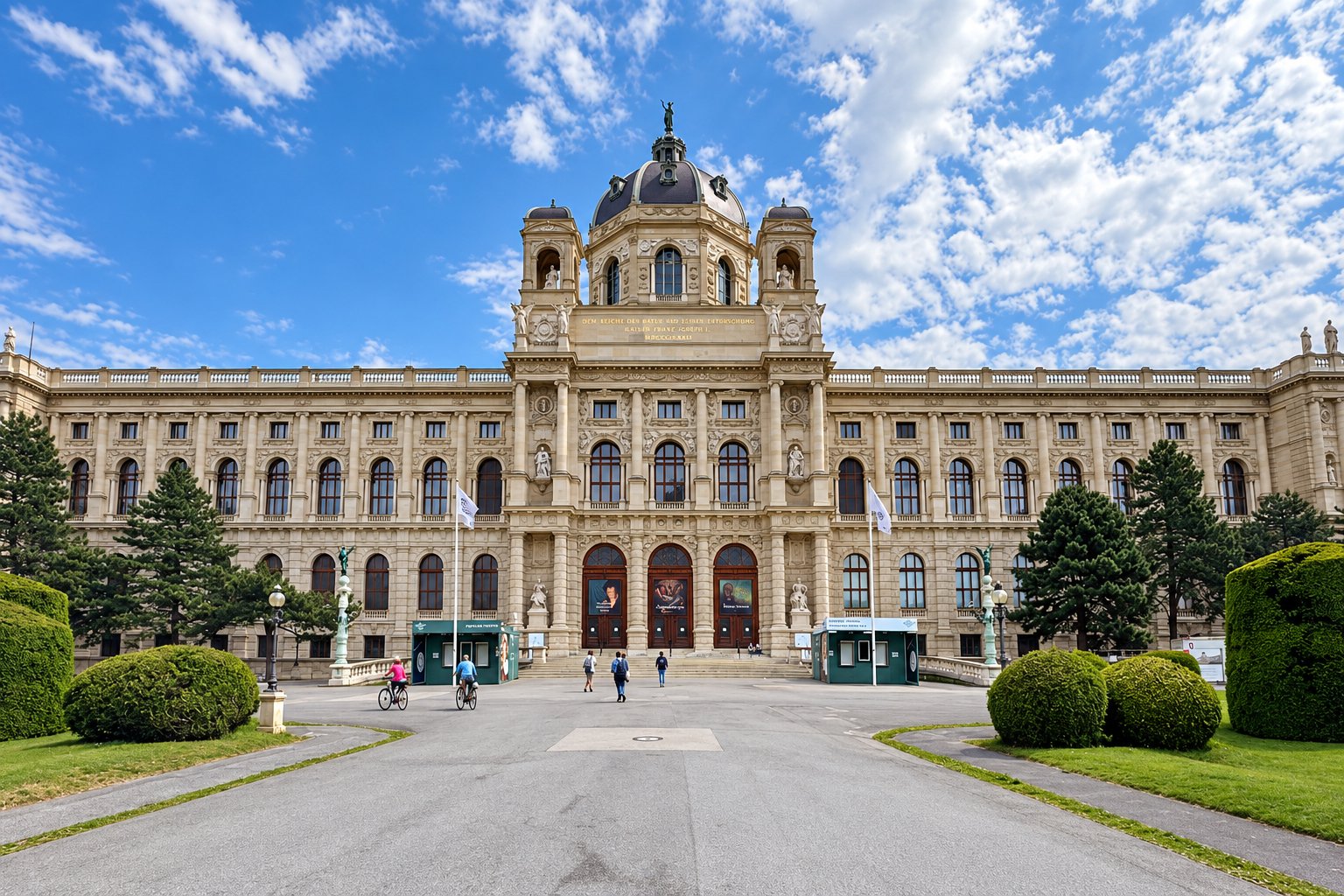
The domed museum building beside Maria-Theresien-Platz is photographed across a broad path, with clipped shrubs flanking the approach. Repeating windows and arches spread outward from the central entrance. The composition is deliberately spacious: the foreground allows the symmetry to register, while the moving clouds keep the sky from becoming an empty background.
The two great museums were major components of the imperial building programme. The Natural History Museum opened in 1889 and the Kunsthistorisches Museum in 1891. Their presence demonstrates the importance attached to collecting and display in the public architecture of the period. The grand museum façade announced the status of the institution before a visitor entered its galleries.
This photograph remains an exterior study. It does not establish which collections were visited or what exhibitions were on view. Instead, it draws attention to the approach itself: the length of the path, the centred doorway, the repeated openings and the dome above them. Those elements make a public building legible from a distance. They also reveal how landscaping and architecture cooperate to create an impression of order.
The Hofburg, Neue Burg and Heldenplatz
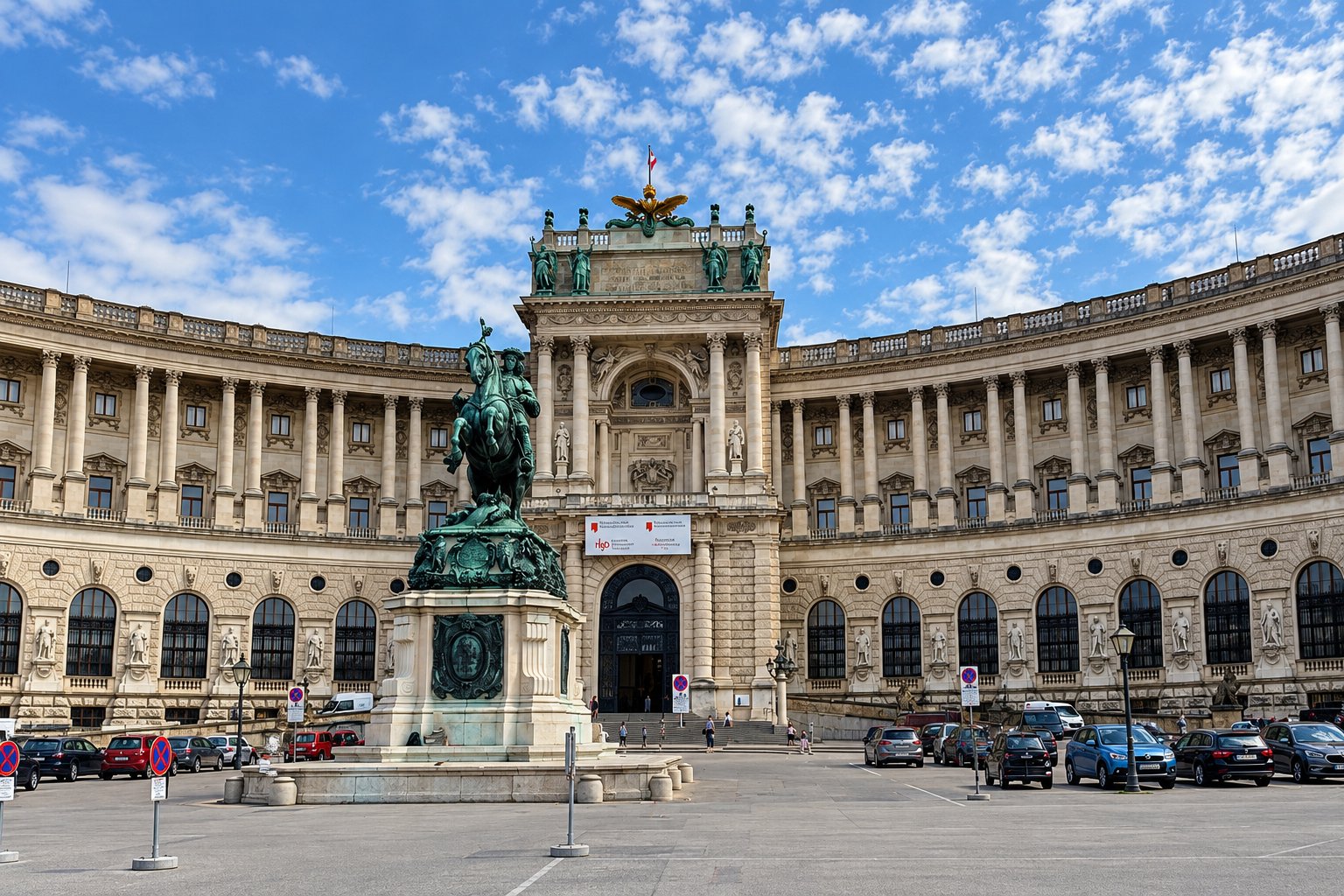
The sweeping Neue Burg frontage changes the shape of the story again. Its long curve gathers the scene around a prominent central section, with repeated columns and windows extending to either side. One photograph includes a lawn; another places the equestrian monument and temporary barriers within the wider paved space. These are related views with different foregrounds and different points of emphasis.
The Hofburg developed over centuries as the seat of Habsburg power. The Neue Burg belonged to the later Imperial Forum scheme, a larger vision that was only partly realized. Its scale reflects the ambitions of the monarchy’s final decades, while its subsequent uses connect the complex with museums, libraries and the interpretation of Austrian history.
Heldenplatz also requires a more difficult historical perspective. In March 1938, Hitler used the balcony of the Neue Burg to address the crowd following Austria’s annexation by Nazi Germany. The square cannot be understood solely through imperial splendour. Its history includes the political uses of architecture and public assembly. Keeping that context beside the photographs makes the view more complete, without reducing the place to a single episode.
A Carriage Crossing the Contemporary City
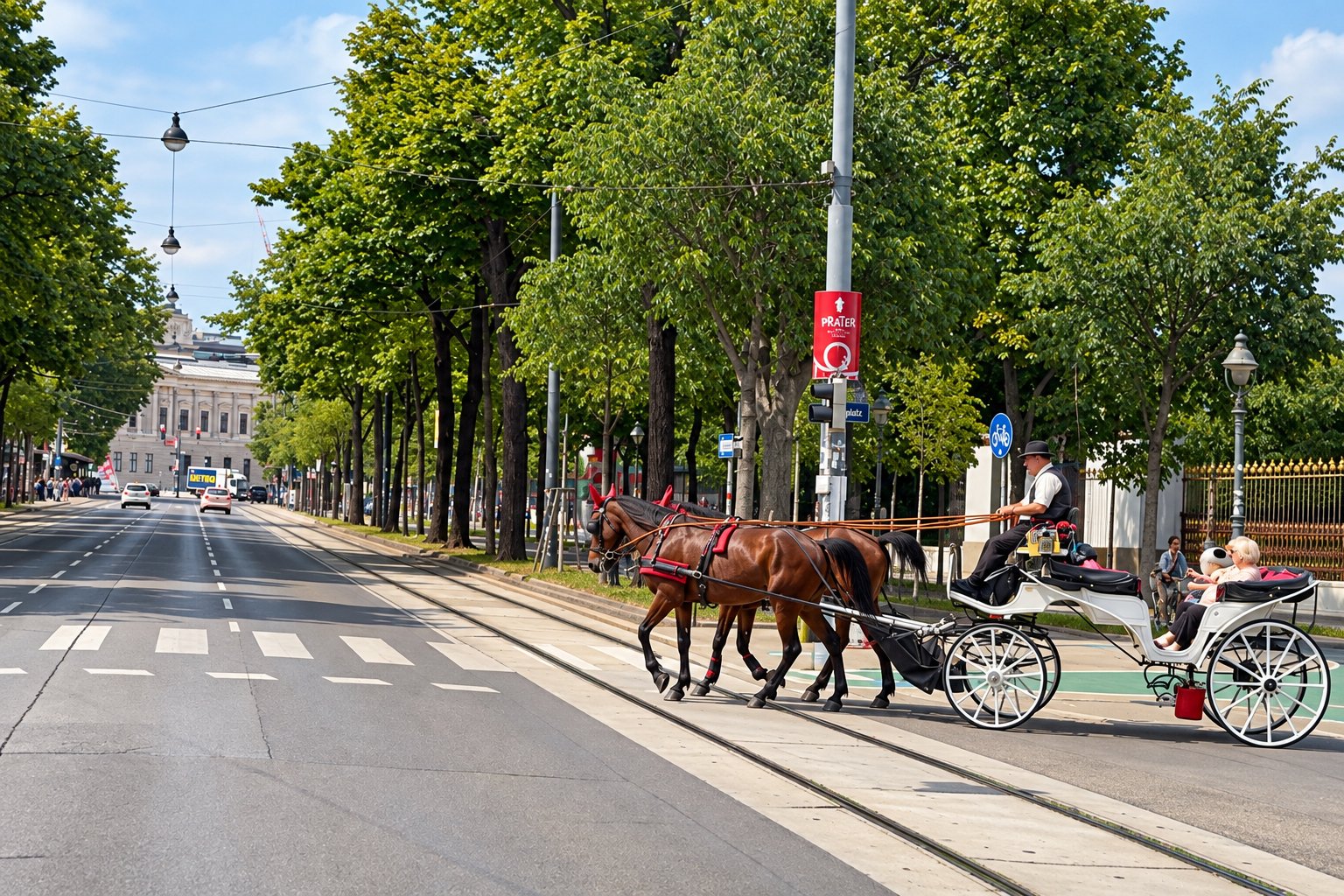
A horse-drawn carriage supplies a different kind of movement from the pedestrians elsewhere in the gallery. The horses cross the road beneath street wiring, beside road markings, signs and modern transport infrastructure. The photograph holds these elements together rather than trying to remove the contemporary setting. The carriage appears within a working street.
Vienna’s fiaker tradition has a long history. The name derives from the Parisian Rue de Saint-Fiacre and was applied to Vienna’s hired coaches in the eighteenth century. The trade expanded strongly during the nineteenth century. The carriage in this picture recalls that transport history, although the photograph itself makes no claim about the route being taken or the purpose of the journey.
Seen together, the thirteen images describe a Vienna of contrasting distances and scales: a cathedral front and a shop display, a crowded street and an open museum approach, a carriage in motion and an enormous palace wall. The historical setting helps those contrasts become readable. The images offer an edited interpretation of the photographed views, while leaving room for a larger collection to develop when more images become available.
Historical Sources
UNESCO — Historic Centre of Vienna
Austrian National Tourist Office — St Stephen’s Cathedral
City of Vienna — The Ringstrasse Period
Vienna Tourist Board — Vienna’s Ringstrasse
Burghauptmannschaft Österreich — Maria-Theresien-Platz
Die Welt der Habsburger — Unveiling of the Maria Theresa Monument
Burghauptmannschaft Österreich — History of the Hofburg